💎 Hidden gem · Jozani, central-south Unguja, 36 km from central Zanzibar
Jozani Chwaka Bay National Park
Red monkeys, whispering mangroves and the island's last wild forest
🎧 Listen to this guide · about 6 min
Pop your earphones in and we'll walk you round.
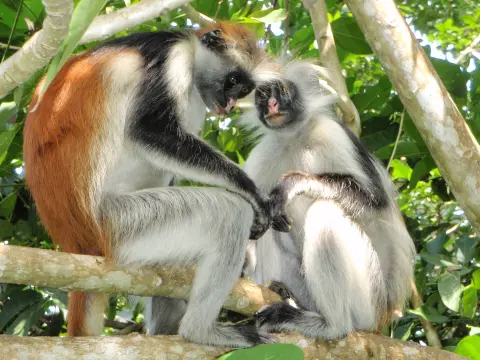
Welcome to Jozani, the green heart of Zanzibar. After the coral stone of town and the white sand of the beaches, this is a different island. Tall trees, cool shade, and the soft noises of the forest. Listen. That rustle overhead is probably a monkey. Not just any monkey. The Zanzibar red colobus, with its rusty red back, pale face and wild white tuft of hair, lives only on this island. Here in Jozani they are used to people, and you can watch them from just a few metres away. Please keep your voice low and your hands to yourself. We are guests in their home. Then we will walk down to the mangroves, where the forest meets the sea.
The story of Jozani Chwaka Bay National Park
Jozani forest grows on low ground in the narrow waist of Unguja, between Chwaka Bay to the north and Uzi Bay to the south. For centuries local people used it for timber, fuel and medicines. In the twentieth century much of Zanzibar's natural forest was cleared for farms and plantations, and Jozani became one of the last large patches left.
The red colobus monkey became the symbol of the forest. It is also called Kirk's red colobus, after Sir John Kirk, the British official in Zanzibar who first brought it to the attention of scientists in the nineteenth century. Kirk was a friend and companion of David Livingstone. Because the monkeys live only on Zanzibar, and their habitat was shrinking, conservationists began working to protect them. Since the mid-1990s the red colobus has been the flagship species for conservation on the island.
In 2004 Jozani Chwaka Bay National Park was created, covering about 50 square kilometres of forest, mangrove and coastal land. It is the only national park on Zanzibar. Part of the money from visitors is shared with the surrounding villages, which helps local people gain from protecting the forest rather than cutting it.
The setting
The park lies about 35 kilometres south-east of Stone Town, beside the main road to the east coast. Near the visitor centre is the groundwater forest, where tall trees grow over a high water table and the ground can be damp. Here paths lead through palms, figs and mahogany, with ferns and vines below. Around the edges, near farms, the red colobus often gather in the trees. A short drive or walk away, on the shore of Chwaka Bay at Pete, a wooden boardwalk crosses a mangrove swamp. The roots rise out of the mud like stilts, and at high tide the water flows in among them.
Why it matters
Jozani is the most important place on Zanzibar for wildlife. It protects the largest population of the red colobus, which is endangered and found nowhere else. It also shelters Sykes monkeys, bush babies, Aders' duiker, the Zanzibar servaline genet, about forty bird species and more than fifty kinds of butterfly. The mangroves protect the coast from storms and act as a nursery for fish. The park's link with local villages is a model for conservation in Africa. When you visit, your fee helps pay rangers and supports the communities who live alongside the forest.
Your walk-through
The stops a guide would take you to, in order.
-
1
The visitor centre
We begin at the visitor centre, where you pay your fee and meet a park guide. Take a look at the displays. They show the forest, its animals and the villages around it. Your guide will explain the rules. Stay at least a few metres from the monkeys, never feed them, and do not use flash. The colobus can catch human illnesses, so if you have a cold, keep your distance a little more.
-
2
The red colobus groups
Now we walk to where the monkeys gather, often in the trees near the farm edges. Look up. See the red backs, the black arms and the pale tuft around the face. Watch how they leap from branch to branch. They live in family groups and feed mostly on leaves, flowers and unripe fruit. Some have been seen eating charcoal, which scientists think helps them cope with toxins in the leaves. Take your time and enjoy them.
-
3
The groundwater forest trail
Next we follow a loop trail into the deeper forest. Notice how the light changes and the air cools. Your guide will point out trees used in traditional medicine, and huge old mahogany and fig trees. Listen for birds and look for butterflies in the sunny gaps. Sykes monkeys, darker and greyer than the colobus, may be watching you from above. Walk quietly and you will see more.
-
4
The mangrove boardwalk at Pete
Now we come to the mangrove boardwalk. Step onto the wooden path and look down. The tangled roots hold the mud together and filter the water. Small crabs scuttle over the mud and fish shelter among the roots at high tide. Several kinds of mangrove grow here, each suited to a different level of the tide. This forest of roots is a nursery for the sea, and a wall against storms.
-
5
The end of the boardwalk
At the end of the boardwalk, pause and look out. This is where the island's forest meets the waters of the bay. Mangroves like these are disappearing around the world, cut for timber and cleared for building. Here they are protected. Take a deep breath of that salty, earthy air. Then we will walk back to the road, past the monkeys once more if they are still nearby.
Things you might not know
- Jozani was declared a national park in 2004 and is Zanzibar's only one.
- The red colobus is named after Sir John Kirk, a companion of David Livingstone.
- Zanzibar red colobus have been observed eating charcoal.
Researched November 2026 from: en.wikipedia.org, en.wikipedia.org, lonelyplanet.com, migrationology.com. Fees and hours change, so check on the day.