⭐ Must-see · Northeast Yellowstone, 110 km from central Yellowstone
Lamar Valley
Wolves at dawn, bison in the snow, and room to breathe
🎧 Listen to this guide · about 6 min
Pop your earphones in and we'll walk you round.
It is just before sunrise, and we are parked at a pullout above the Lamar River. Engines off. Voices low. Along the road, people stand beside spotting scopes, coffee in hand, scanning the slopes. Down in the valley, dark shapes move through the sage. Bison, hundreds of them. On the far hillside, someone whispers that a wolf is moving along the ridge. Look through the scope and there it is, grey against the snow. This is Lamar Valley, wide, open and wild. It is one of the few places in the world where you can watch wolves living their lives in the open. Patience is everything here. Let's settle in.
The story of Lamar Valley
The river here was once called the East Fork of the Yellowstone. In the 1880s, geologist Arnold Hague renamed it after Lucius Q.C. Lamar, then Secretary of the Interior. For thousands of years before that, Native peoples hunted and travelled through this valley.
By the early 1900s, bison were nearly gone from the country. Yellowstone's wild herd had fallen to a small remnant. In 1907 the park moved bison to this valley and founded the Lamar Buffalo Ranch, raising and protecting them to rebuild the herd. The ranch's buildings, dating from 1915 to the 1930s, still stand, and today the nonprofit Yellowstone Forever uses them for classes.
Wolves had a harder story. Rangers and hunters killed them for decades, and the last official killing in the park came in 1926, when two pups were shot near Soda Butte Creek. For nearly seventy years Yellowstone had no wolf packs. Then, in 1995, fourteen wolves captured in Alberta, Canada, were released from pens at Crystal Creek, Rose Creek and Soda Butte Creek, all in or near this valley. Seventeen more followed in 1996. Their descendants still roam here. At the end of 2023, the park counted more than a hundred wolves in eleven packs.
The setting
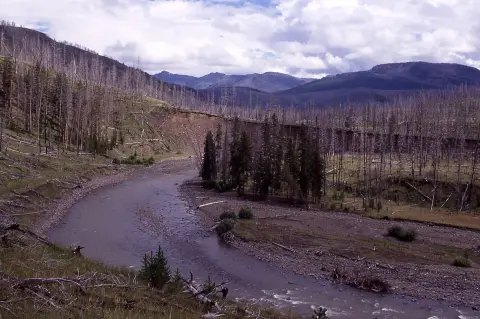
Lamar Valley stretches for many kilometres along the Lamar River, between Lamar Canyon in the west and the meeting of Soda Butte Creek in the east. It is a glacial valley, wide and flat-bottomed, with rolling slopes of sage and grass and scattered patches of aspen and Douglas fir. Peaks of the Absaroka Range rise to the north and east. Slough Creek joins from the north near the western end. The Northeast Entrance Road runs the length of the valley, with pullouts where visitors watch wildlife. Because this road is the only one in the park open to cars all year, Lamar is one of the few places you can drive to in winter.
Why it matters
Lamar Valley is where the return of the wolf became visible to the world. The reintroduction of the 1990s is one of the most studied wildlife restorations anywhere, and much of that research happened in these hills. Wolves from the Druid Peak release pen of 1996 became one of the most watched wolf families on Earth. Yellowstone is also the only place in the United States where bison have lived continuously since prehistoric times, and this valley is central to that story. Here you can see a whole ecosystem, predators and prey together, much as it was centuries ago.
Your walk-through
The stops a guide would take you to, in order.
-
1
Slough Creek turnout
Our first stop is near Slough Creek, at the western edge of the valley. Wolves have often denned in the hills to the north, and watchers gather here early. Scan the open slopes and the tree line. Look for movement, then for ravens circling, which often means a carcass. Keep at least 100 yards from wolves and bears, by law.
-
2
Lamar Canyon
The road now squeezes through Lamar Canyon, where the river rushes between dark boulders. Look for river otters in the pools and dippers bobbing on the rocks. When the canyon opens, the valley spreads out before you. It is one of the best moments of the drive.
-
3
Valley pullouts
As the valley opens, pull over at one of the large pullouts. Here you may see bison by the dozen, sometimes by the hundred. In winter they swing their heads to sweep snow from the grass. Watch the far hills for elk, pronghorn and coyotes. Never block the road, and keep at least 25 yards from bison.
-
4
Lamar Buffalo Ranch
Look to the north side of the road for a cluster of old wooden buildings. This is the Lamar Buffalo Ranch, founded in 1907 to help save Yellowstone's bison. Hay grown here fed the herd through winters for decades. Today it is a field school. The buildings are not open for casual visits, but the story behind them is worth a pause.
-
5
Confluence with Soda Butte Creek
At the east end of the valley, Soda Butte Creek joins the Lamar. Near here, in 1995, some of the first wolves were released from their pens. Some of the last wolves killed in the park, two pups in 1926, died near this same creek. The circle closed in this place.
-
6
Soda Butte
Our last stop is Soda Butte, a low, pale mound beside the road. It is an old travertine cone, built by a hot spring long ago and now almost dry. It gave the creek its name. Beyond it, the road climbs toward the Northeast Entrance and the mountain town of Cooke City.
Things you might not know
- The last wolves officially killed in Yellowstone were two pups, shot in 1926 near Soda Butte Creek.
- Fourteen wolves from Alberta were released in or near Lamar Valley in 1995.
- The road through Lamar Valley is the only road in Yellowstone open to cars all year.
Researched November 2026 from: en.wikipedia.org, en.wikipedia.org, en.wikipedia.org, nps.gov. Fees and hours change, so check on the day.