⭐ Must-see · West Potomac Park, 2 km from central Washington, D.C.
Tidal Basin
Cherry blossoms, still water and three great memorials
🎧 Listen to this guide · about 6 min
Pop your earphones in and we'll walk you round.
Welcome to the Tidal Basin. In late March or early April, this water is circled by thousands of cherry trees in soft pink and white. Petals drift on the breeze and settle on the surface like snow. But this loop is worth walking in any season. Along its edge stand three of Washington's finest memorials, to Thomas Jefferson, Martin Luther King Jr. and Franklin Delano Roosevelt. The path is about two miles around and almost flat. We will walk it clockwise, starting near the Jefferson Memorial and finishing at the King memorial. Take your time. This is a place for slow walking and looking up.
The story of Tidal Basin
The Tidal Basin was built on purpose. In the late 1800s, the Army Corps of Engineers dredged the Potomac and used the mud to create new parkland. They shaped this inlet so that tides could flush the nearby Washington Channel clean. It was finished in the 1890s.
The cherry trees came as a gift of friendship. In 1912 the city of Tokyo, led by Mayor Yukio Ozaki, sent 3,020 trees. An earlier shipment in 1910 had arrived infested with insects and had to be destroyed. On March 27, 1912, First Lady Helen Taft and Viscountess Chinda, wife of the Japanese ambassador, planted the first two trees. Both still stand near the southern end of 17th Street. In 1915 the United States sent flowering dogwoods to Japan in return.
The memorials followed. The Jefferson Memorial was dedicated in 1943, on the 200th anniversary of his birth. The Franklin Delano Roosevelt Memorial opened in 1997, and the Martin Luther King Jr. Memorial in 2011. Most recently, the old, sinking seawalls were rebuilt, and the basin fully reopened in April 2026 with hundreds of new trees, many of them cherries.
The setting
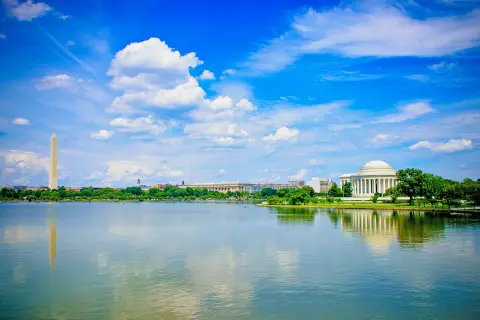
The basin is a roughly round body of water on the south side of the National Mall, between the Washington Monument and the Potomac River. A paved path circles it. On the south side sits the Jefferson Memorial, a round, domed building with a columned porch. On the west side, set among trees, are the long granite rooms of the Roosevelt memorial and the white stone of the King memorial. Most of the cherry trees are Yoshino, with white-pink blossoms. The view across the water to the Washington Monument is one of the best in the city. A small bridge carries the path over the inlet that connects the basin to the river.
Why it matters
The cherry trees are a living symbol of friendship between the United States and Japan, and the National Cherry Blossom Festival draws visitors from around the world each spring. The memorials around the basin honour three people who shaped American life in very different eras. Together they make this loop one of the richest short walks in the country. And because the trees are renewed and the seawalls rebuilt, the place is being cared for so the next generations can enjoy it too.
Your walk-through
The stops a guide would take you to, in order.
-
1
The first cherry trees
Start near the southern end of 17th Street, close to the statue of John Paul Jones. Look for two old trees marked by a plaque. These are the two planted by Helen Taft and Viscountess Chinda in 1912. They are more than a century old, gnarled and patched, but still flowering. Nearby stands a large Japanese stone lantern, a gift presented in 1954. It is lit each spring at the opening of the festival.
-
2
Jefferson Memorial
Follow the path around to the round, domed building. The architect John Russell Pope based it on the Pantheon in Rome. Inside, a bronze statue of Jefferson, 19 feet tall, stands under the dome. The first statue here was plaster, because bronze was rationed during the Second World War. It was replaced in 1947. Read the words carved around the top of the room, and the passages from the Declaration of Independence on the walls. Then step out onto the porch and look across the water.
-
3
The view to the White House
From the Jefferson Memorial steps, look straight north across the water. The Washington Monument rises in front of you, and behind it, on a clear day, you can make out the White House. This line was planned. The memorial was placed here to complete a cross-shaped layout of the city's great buildings. In blossom season, this is the classic photograph, with pink branches framing the obelisk.
-
4
Franklin Delano Roosevelt Memorial
Continue west to a long series of outdoor rooms built from red granite. There are four, one for each of Roosevelt's terms as president. Designed by Lawrence Halprin and opened in 1997, they move from the Great Depression to the Second World War. Waterfalls grow louder and more broken as the story grows harder, then calm again. Look for the bronze breadline, and the statue of Roosevelt's dog Fala. Near the entrance, a statue shows Roosevelt in a wheelchair.
-
5
Martin Luther King Jr. Memorial
Finish at the great white stone. The design draws on a line from King's 1963 speech about hewing a stone of hope out of a mountain of despair. You walk through a gap in the mountain, and the Stone of Hope stands forward, with King's figure carved into it, about 30 feet high, by the sculptor Lei Yixin. The memorial opened in 2011. Its address is 1964 Independence Avenue, a nod to the Civil Rights Act of 1964. Read the quotations on the curved wall behind.
Things you might not know
- Tokyo's first gift of cherry trees, sent in 1910, had to be destroyed because the trees were infested with insects; the 1912 replacement shipment numbered 3,020 trees.
- The original statue in the Jefferson Memorial was plaster because of wartime metal rationing; the bronze replacement was installed in 1947.
- The Martin Luther King Jr. Memorial's address, 1964 Independence Avenue, refers to the Civil Rights Act of 1964.
Researched November 2026 from: nps.gov, nps.gov, doi.gov, en.wikipedia.org. Fees and hours change, so check on the day.