🚗 Day trip · San Cristóbal, Nor Lípez, 95 km from central Uyuni Salt Flats
San Cristóbal Church
A colonial church that moved for a mine
🎧 Listen to this guide · about 6 min
Pop your earphones in and we'll walk you round.
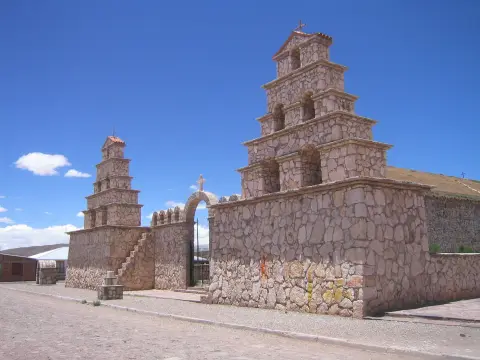
Welcome to San Cristóbal, a mining town south of Uyuni. In its centre stands an old stone church that has a surprising story. It was not built here. In 1999, it was taken apart stone by stone and rebuilt in this place, because a huge mine was planned under the old village. Look at its walls, bell tower and doorway. They are centuries old, even if the spot is new. Around it, the town has a modern look, with mining company buildings and new houses. This is a place where old and new Bolivia meet. Walk around slowly and imagine the work of moving a whole church.
The story of San Cristóbal Church
The original village of San Cristóbal was a small community in the Lípez region, with a colonial church built in the seventeenth century. The church was simple outside, with thick stone walls, and it is described as Baroque in style, with colonial decoration inside.
In the 1990s, geologists found a large deposit of silver, zinc and lead beneath the village. A mining company planned an open pit mine on the site. To make way for it, the village and its church were relocated. In 1999 the church was dismantled stone by stone and rebuilt in the new town, about twenty kilometres away.
The mine began production in the following years and became one of the largest of its kind in the world. It changed the region, bringing jobs and money, but also new challenges for the environment and water supply. In 2023, the mine was sold by the Japanese company Sumitomo to San Cristobal Mining Inc. The church remains the heart of the town, and a symbol of what was saved. For local families, keeping the church was a way to keep their history and identity, even as their village disappeared.
The setting
The church stands on a plaza in the new town of San Cristóbal. It has thick stone walls, a bell tower and a carved doorway. Inside, you may see altars, paintings and decorations from the colonial period. Around the plaza are shops, offices and houses. The town is surrounded by dry hills and the plain of the Lípez region. Not far away is the huge open pit mine, with its terraces and trucks. The town lies at high altitude in a dry, windy landscape, and nights here are very cold for much of the year. Many tours to the south stop here briefly for fuel, supplies and a look at the church.
Why it matters
San Cristóbal's church is a rare example of a historic building moved to make way for modern industry. It shows how communities balance heritage with economic change. For visitors, it is a chance to see a colonial church in the southern Altiplano, and to think about the costs and benefits of mining. The story is still unfolding, as people here look to the future when the mine eventually closes. It also shows how quickly life can change in a mining region, for better and for worse.
Your walk-through
The stops a guide would take you to, in order.
-
1
The plaza
Start on the plaza in front of the church. Look at the building's shape and walls. Notice how carefully the stones fit together. Each was numbered and moved, then put back in place. It is like a puzzle on a huge scale. Look too at how the plaza has been laid out around the church, giving it pride of place in the new town.
-
2
The doorway
Walk to the main door. Look at the carvings around it. These show the skill of colonial craftsmen. Imagine people entering through this door in the original village, centuries ago. Notice the thick stone walls on each side of the door. They kept out the cold and made the church a solid shelter in a harsh land. Look for any dates or inscriptions in the stone.
-
3
Inside the church
If the church is open, step inside quietly. Look at the altars and paintings. Many are from the colonial period. Remember that this is a working church. Be respectful, especially during services. Look for the main altar and the side altars. Notice the details in the wood and the paintings, many showing saints important to local people. Stay a moment in the quiet if you can.
-
4
The bell tower
Step back outside and look up at the bell tower. It was also moved stone by stone. Think about the care needed to rebuild it safely, so that it stands straight and strong. Listen if the bells ring for a service. Their sound carries far across the open plain. They have called people to prayer for many generations, first in the old village and now here.
-
5
The town and the mine
Finally, look around at the modern town. Many people here work at the mine. From some points you may see the mine's terraces in the distance. It is a reminder of why the church had to move. Take a last look at the church before you leave. It stands as a link between the old village and the new town, and between Bolivia's colonial past and its mining present.
Things you might not know
- The church was moved stone by stone in 1999.
- It was relocated about 20 kilometres to make way for a silver, zinc and lead mine.
- The mine was bought from Sumitomo by San Cristobal Mining Inc in 2023.
Researched November 2026 from: lonelyplanet.com, en.wikipedia.org, es.hispanopedia.com. Fees and hours change, so check on the day.