⭐ Must-see · Las Cañadas del Teide, 45 km from central Tenerife
Teide National Park
Above the clouds, where the island was born in fire
🎧 Listen to this guide · about 6 min
Pop your earphones in and we'll walk you round.
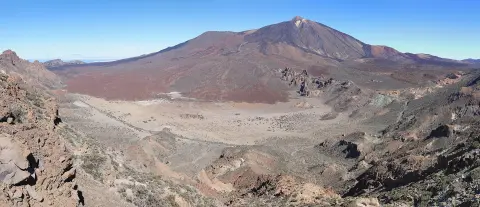
Welcome to the roof of Spain. We have climbed out of the sea of cloud, and now look around you. The air is thin and clear. The ground is red, black and gold. And there, rising over everything, is Teide, a volcano so big it seems to make its own weather. The old islanders believed this mountain was a gateway to the underworld. Today it is a national park and a World Heritage Site, and on a clear day you can see the other Canary Islands floating on the horizon. Take a slow breath. Walk gently. This is a place to look, to listen to the silence, and to feel how young and restless this island really is.
The story of Teide National Park
Long before the Spanish arrived, the Guanches, the native people of Tenerife, grazed goats up here in summer. They saw the peak as sacred and fearful. Legend says a demon called Guayota lived inside the mountain, and that he once stole the sun and hid it in the crater until the god Achamán freed it. Shepherds left traces of their camps and shelters across these high plains.
The volcano never really slept. In 1798 the flank of Pico Viejo, Teide's older neighbour, split open and lava poured out for about three months. People call those vents the Narices del Teide, the nostrils of Teide. The most recent eruption on the island came in November 1909, at Chinyero, on the ridge to the north-west.
In 1954 Spain declared the area a national park, one of the first in the country. A cable car opened in 1971, carrying visitors to an upper station at 3,555 metres. Then, in 2007, UNESCO added the park to its World Heritage list for its natural beauty and for what it shows about how ocean islands grow. Today it is the most visited national park in Spain, with more than four million visitors in 2023.
The setting
The park sits inside a vast crater-like basin called Las Cañadas, around sixteen kilometres across, with a broken wall of cliffs on its south side. Teide stands on the northern rim of this bowl, reaching 3,718 metres as it is usually measured. Beside it rises Pico Viejo, the second highest volcano in the Canaries. The floor of the basin is a patchwork of lava flows, pumice and pale sand plains. In late spring the tall red tajinaste flowers shoot up like candles, and the small Teide violet grows higher than any other flowering plant in Spain. To the east, white domes of the Teide Observatory catch the light.
Why it matters
Teide matters to scientists and to islanders alike. Its clear, dry air makes it one of the best places in Europe to study the sun and the stars. Its Mars-like ground has been used to test instruments for space missions. For geologists it is a living classroom on how volcanic islands grow and collapse. And for the people of Tenerife it is simply home, the mountain you see from almost every village, the first thing sailors spotted for centuries. It reminds every visitor that this island is still being made.
Your walk-through
The stops a guide would take you to, in order.
-
1
Roques de García viewpoint
Start at the car park opposite the parador. In front of you is a line of twisted rock towers, the Roques de García. The famous one, Roque Cinchado, is narrow at the base and wide at the top, like a stone tree. It is the old core of volcanic rock that resisted wind and frost while softer layers wore away. It once appeared on Spain's thousand peseta banknote, with Teide standing behind it.
-
2
Llano de Ucanca
Turn and look down onto the flat plain below. This is the Llano de Ucanca. Water from rain and snow collects here and leaves fine sediment, so the floor is smooth and pale against the dark lava. Film crews have used these plains to stand in for other planets. Watch how the colours shift as clouds pass over. At sunset the cliffs behind turn copper.
-
3
Cable car base station
Drive or take the bus a few minutes north to the cable car at the foot of Teide, around 2,350 metres up. The cabin climbs about 1,200 metres in a few short minutes. Notice the change in the air as you rise. Take it easy at the top. People with heart or breathing problems are advised not to go up.
-
4
La Rambleta upper station
You step out at 3,555 metres. Short paths lead to two viewpoints. One looks over to Pico Viejo and its great crater. The other looks east to the observatory and, on a clear day, to Gran Canaria. You may smell sulphur. Small vents near the summit still release warm gas. The final climb to the crater rim needs a free permit booked in advance.
-
5
Minas de San José
On your way back south, stop at the Minas de San José. Here the ground is pale pumice, soft as sand, broken by black streaks of lava. It feels like walking on the moon. The name comes from old diggings for pumice. Stay on the marked paths, as the surface is fragile and every footprint lasts a long time here.
Things you might not know
- Teide is the highest point in Spain and the highest volcano on any Atlantic island.
- The Teide violet grows near the summit and is the highest flowering plant in Spain.
- The park's Mars-like terrain has been used to test instruments for space missions such as ExoMars.
Researched November 2026 from: whc.unesco.org, en.wikipedia.org, volcanoteide.com, en.wikipedia.org. Fees and hours change, so check on the day.