🚗 Day trip · San Cristóbal de La Laguna, 85 km from central Tenerife
San Cristóbal de La Laguna Old Town
The first colonial grid town, where the Americas found their blueprint
🎧 Listen to this guide · about 5 min
Pop your earphones in and we'll walk you round.
Welcome to La Laguna, where you will find a different Tenerife. Up here the air is cooler, the light softer, and the streets are made for walking. Pastel walls, carved wooden balconies, hidden courtyards full of ferns. Students on bikes, families at café tables, church bells across the rooftops. This was the first capital of the island, and its old centre is a World Heritage Site. What makes it special is not one building but the whole town plan. Its straight streets and open squares became a model for cities across Latin America. So stroll slowly, peek through open doorways, and enjoy a town that still feels lived in.
The story of San Cristóbal de La Laguna Old Town
After the conquest of Tenerife in 1496, the conqueror Alonso Fernández de Lugo founded a new town on a high plain beside a shallow lake, or laguna, which gave the place its name. Sources differ on whether the founding came in 1496 or 1497, but either way it was among the first acts of Spanish rule on the island.
The town was laid out in two parts: an older, more irregular upper town, and a lower town planned on a grid of straight streets. Unusually, it had no defensive walls, as the island had already been taken. This open grid became a pattern later used in many cities founded in the Americas. La Laguna was the island's capital and seat of government for centuries, home to nobles, merchants and religious orders. In 1792 the University of La Laguna had its beginnings, and in 1819 the town became the seat of a bishop.
The capital later moved to Santa Cruz, beside the port, and La Laguna kept much of its old form. In December 1999 UNESCO added its historic centre to the World Heritage list.
The setting
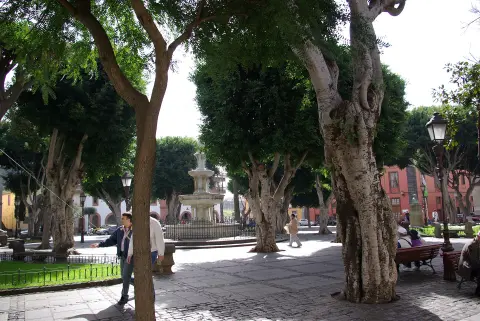
La Laguna lies on a wide plain at around 550 metres, between the Anaga mountains and the slopes of the island's centre. Clouds often drift in from the north, keeping it green and cool. The historic centre is compact and flat, perfect for walking. Long straight streets, many now pedestrian, run between low houses of two storeys with stone doorways and wooden balconies. Bright facades in ochre, blue and red face onto squares shaded by trees. Churches, convents and mansions with inner courtyards line the main routes.
Why it matters
UNESCO calls La Laguna the first example of an unfortified Spanish colonial town laid out on a grid. In other words, it is a prototype for many cities across Latin America. It is also a living town, home to the island's university and its bishop, full of students and local life. Its old houses show the Canary style of building, mixing Andalusian, Portuguese and local influences. For Tenerife, it is the cultural heart of the island.
Your walk-through
The stops a guide would take you to, in order.
-
1
Plaza del Adelantado
We start in the Plaza del Adelantado, named after the conqueror Alonso Fernández de Lugo, who held the title of adelantado. Around the square you will see the old town market, a convent and fine mansions. Look at the wooden balconies and stone doorways. This square was the heart of the lower town, the planned grid that later inspired the Americas.
-
2
Calle San Agustín
Walk along Calle San Agustín, one of the most elegant streets in town. Notice how straight it runs. Grand houses line both sides, some with courtyards you can glimpse through open doors. Look for ferns and wooden galleries inside. Several buildings now house public offices and cultural centres, so you may be able to step in.
-
3
Cathedral of La Laguna
Turn towards the Cathedral of Our Lady of Los Remedios, the only cathedral on Tenerife. Its front is neoclassical, and the building was largely rebuilt in the early twentieth century, with major restoration completed in 2014. Inside, it is light and calm. Look for the tomb of Alonso Fernández de Lugo, the conqueror and founder of the town.
-
4
Calle de la Carrera
Now walk Calle de la Carrera, the main street of the old town. Shops, cafés and bookshops fill old houses. Look for the town hall and its painted rooms. This is where students and locals meet. Stop for a coffee and a pastry, and watch the life of the town go by.
-
5
Church of La Concepción
Finish at the Church of La Concepción in the upper town. It is considered the town's oldest parish, founded soon after the conquest. Look up at its tall stone bell tower, a symbol of La Laguna. Inside are beautiful wooden ceilings in Mudéjar style. If the tower is open, climb it for a view over the rooftops.
Things you might not know
- La Laguna's historic centre was added to the UNESCO World Heritage list in December 1999.
- Its open, unwalled grid plan became a model for many towns in the Americas.
- It holds the only cathedral on Tenerife.
Researched November 2026 from: whc.unesco.org, turismo.aytolalaguna.es, tenerife.es. Fees and hours change, so check on the day.