💎 Hidden gem · Kadriorg, 3 km from central Tallinn
Tallinn Song Festival Grounds
The hillside where Estonia sang itself free
🎧 Listen to this guide · about 6 min
Pop your earphones in and we'll walk you round.
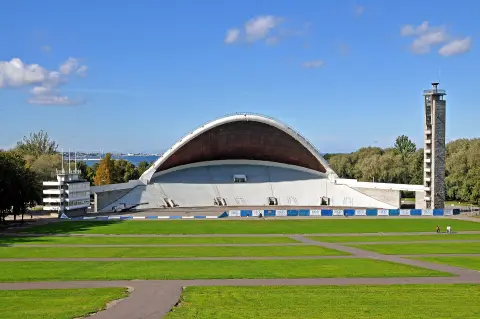
Look around you. A wide green slope rolls down to a huge arched stage, like a giant seashell. Beyond it lies the sea. On an ordinary day there might be a few dog walkers here, a jogger, the wind in the grass. But close your eyes and imagine tens of thousands of singers on that stage, and a crowd filling the hill, all singing the same song. That is what happens here every few years at the Estonian Song Festival. And in 1988, in the last years of Soviet rule, it happened in a way that changed history. This is one of the most meaningful places in Estonia, and few visitors come. Walk up the slope with me, and I will tell you why it matters.
The story of Tallinn Song Festival Grounds
The Estonian Song Festival began in 1869, in Tartu, led by Johann Voldemar Jannsen. At that time Estonia was part of the Russian Empire, and Estonian was the language of peasants. Singing together in their own language helped spark the national awakening, and the festival became a symbol of Estonian identity. It is held about every five years.
The festival moved to Tallinn, and in 1928 the first stage was built on this site, designed by Karl Burman. The current arched stage, designed by Alar Kotli, Henno Sepmann and Endel Paalmann, was completed in 1959 and first used for the 1960 festival. Under Soviet rule, the song festival went on, with obligatory songs praising the regime. But choirs kept singing 'Mu isamaa on minu arm', My Fatherland Is My Love, set to music by Gustav Ernesaks in 1944. It became an unofficial national anthem.
In 1988, during the summer, huge crowds gathered here night after night to sing patriotic songs. The activist Heinz Valk named it the Singing Revolution. Over the next three years, peaceful protest and song helped Estonia restore its independence on 20 August 1991.
The setting
The grounds lie on a natural slope on the edge of Kadriorg, just inland from Pirita Road and the sea. At the foot of the slope stands the stage arch, a bold modernist shell open toward the hill, designed to project the sound of a huge choir up the slope. The hill above, a wide lawn, holds the audience. On the north side stands a tall fire tower, which is lit during festivals. At the top of the slope, a statue of Gustav Ernesaks sits looking down at the stage. Behind you, Kadriorg Park and the Old Town spires; ahead, Tallinn Bay.
Why it matters
Song festivals are on the UNESCO list of the Intangible Cultural Heritage of Humanity, shared by Estonia, Latvia and Lithuania. For Estonians, this hill is close to sacred. Families travel from across the country to sing or listen here, wearing folk costumes from their home parish. The memory of 1988, when singing replaced violence, is central to how the nation sees itself. The grounds also host big concerts in summer and ice skating or events in winter. For a visitor, coming here is a way to understand the gentle, stubborn spirit of this small country.
Your walk-through
The stops a guide would take you to, in order.
-
1
The main entrance and visitor centre
Start near the entrance on Narva Road. If the visitor centre is open, step in to learn more about the song festival and its history. You will see old photographs, costumes and recordings. Listen to a few songs from past festivals, and try to imagine thirty thousand voices together.
-
2
The stage arch
Walk down to the stage. Stand under the great arch and look up. Its curved shell was designed to send sound up the slope, so that even the back rows can hear every choir. Turn around and look up the hill. During a festival, the whole lawn is a sea of people, many in striped skirts and embroidered blouses.
-
3
The fire tower
Look to the north side of the stage at the tall tower. During each song festival, a flame is lit here, carried in a relay from Tartu, where the first festival took place. It is a symbol of continuity, linking every festival back to 1869.
-
4
The slope
Now climb the slope slowly. This is where the audience sits, standing or lying on the grass. In the summer of 1988, ordinary people gathered here in the evenings to sing songs that had been forbidden or frowned upon. Blue, black and white flags, illegal for decades, appeared in the crowd. No one fired a shot, and yet everything started to change.
-
5
Gustav Ernesaks statue
Near the top of the slope sits the statue of Gustav Ernesaks, the conductor and composer, unveiled in 2004. He wrote the music for 'Mu isamaa on minu arm', which choirs sang as a quiet act of resistance in Soviet times. His statue looks down at the stage, as if still conducting. On his birthday, 12 December, male choirs gather here to sing.
-
6
The view of the sea
Finish at the top of the hill and look out. The stage, the trees of Kadriorg, the bay and on a clear day the Old Town spires to the west. This view is what singers see when they walk out from the stage, and what the crowd sees when they stand to sing. Take a moment here before heading on.
Things you might not know
- The first Estonian Song Festival was held in 1869 in Tartu.
- The current arched stage was finished in 1959 and first used for the 1960 festival.
- The Baltic song and dance celebrations are listed by UNESCO as Intangible Cultural Heritage.
Researched November 2026 from: en.wikipedia.org, en.wikipedia.org, visitestonia.com, lauluvaljak.ee. Fees and hours change, so check on the day.