⭐ Must-see · Djurgården, 3 km from central Stockholm
Vasa Museum
A royal warship lost in minutes, found three centuries later
🎧 Listen to this guide · about 6 min
Pop your earphones in and we'll walk you round.
Welcome to the Vasa Museum. Step through the doors and let your eyes adjust to the dim light. Then look up. In front of you is a real warship from the 1620s, towering over several floors, dark with age and covered in carvings. It is not a model. It is not a reconstruction. Almost every piece of wood you see sailed out of Stockholm harbour in 1628, and sank only minutes later. The air is kept cool and the lights low to protect her. Take your time. Walk around her on every level, and you will see lions, warriors, mermaids and kings staring back at you from the old oak.
The story of Vasa Museum
In the 1620s Sweden was at war, and King Gustav the Second Adolf wanted a mighty navy. He ordered a new warship, and the Dutch-born shipwright Henrik Hybertsson began building her at the navy yard in Stockholm in 1626. Master Henrik fell ill and died in 1627, and his assistant Henrik Jacobsson finished the job. The ship was named Vasa, after the royal family. She carried 64 bronze guns and was decorated with hundreds of carved and painted sculptures.
On 10 August 1628, Vasa set sail on her maiden voyage in front of a crowd. She had travelled only about 1,300 metres when a gust of wind made her heel over. Water poured in through the open gunports, and she sank in the harbour. Around thirty people are thought to have died. An inquiry followed, but no one was punished. The ship was simply too unstable, top-heavy and too narrow for her weight.
Most of her guns were salvaged in the 1660s, then Vasa was forgotten. In 1956 the amateur researcher Anders Franzén found her again. On 24 April 1961 the hull broke the surface after 333 years. The cold, brackish water of the Baltic had protected her from the shipworm that destroys wood in saltier seas. For seventeen years she was sprayed with a preserving chemical, polyethylene glycol, and then slowly dried. In 1990 this museum opened around her.
The setting
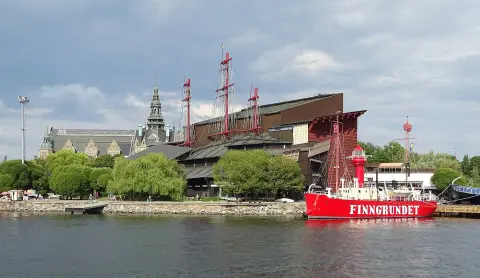
The museum stands on the island of Djurgården, at the water's edge. From outside you will notice the masts poking through the copper roof. They show the height of the ship's original masts. Inside, the building was designed around the ship itself. Vasa sits in one great hall, and you can view her from seven levels, from the keel at the bottom to the top of the stern. Around her are exhibitions on life aboard, the people found in the wreck, the sculptures and their original bright colours, and the long work of conservation. The hall is kept dark and cool, with careful control of humidity, because the old wood is still fragile.
Why it matters
Vasa is the world's best preserved seventeenth-century ship, and much of what she is made of is original. She is a time capsule of shipbuilding, warfare and daily life in the 1600s. Scientists still study her wood and the chemistry of her preservation, and the lessons learned here are used for other wrecks around the world. The museum is Scandinavia's most visited museum, with tens of millions of visitors since 1990. It also tells a human story about ambition and pressure, and about a mistake that sank a king's pride in front of the whole city.
Your walk-through
The stops a guide would take you to, in order.
-
1
The model on the entrance level
Before you look closely at the real ship, find the scale model near the entrance. It shows Vasa as she looked in 1628, with full rigging and her carvings painted in red, blue and gold. Researchers worked out these colours from tiny traces of paint left on the wood. Keep this picture in your mind. As you walk around the real ship, try to imagine her bright and new, gleaming on that summer day.
-
2
The stern
Walk round to the stern, the back of the ship. This was her proudest face. At the top is the Swedish royal coat of arms, held by two lions. Below are rows of carved figures: Roman emperors, warriors and mythical creatures. The message was power and glory. Look for the young king himself, Gustav Adolf, shown as a boy with long hair, flanked by griffins. These carvings were meant to impress friends and frighten enemies.
-
3
The lion figurehead
Now go to the bow, the front. Here you will see the great lion figurehead, leaping forward as if to attack. The lion was a symbol of the king himself, sometimes called the Lion of the North. Around the bow are more carved faces and figures. Lean in and look at the detail in the manes and the claws. Remember, these were made by hand, by carvers working in Stockholm almost four hundred years ago.
-
4
The gun deck and the replica
Find the full-size reconstruction of part of the gun deck. Here you can feel how cramped life was aboard. Gunners slept and worked beside the heavy bronze cannons. On the day she sank, the lower gunports were open, perhaps for a salute. When the ship heeled over, water rushed straight in through those openings. Look at how low they sit above the waterline. That small distance made all the difference.
-
5
The people of Vasa exhibition
Downstairs you will meet the people of Vasa. Remains of at least fifteen people were found during the salvage. Scientists have studied their bones and teeth, and artists have made facial reconstructions. You can read about their ages, their health and the work they did. Please take this part slowly and respectfully. These were real sailors and their families, who died in the harbour within sight of home.
-
6
The keel level and conservation display
End at the lowest level, close to the keel. From here the ship looks enormous above you. Nearby, displays explain how Vasa was raised and preserved, and the challenges that remain, such as acids forming in the wood and the steel bolts that once held her together. A new support frame now carries her weight. The work to keep Vasa safe for future generations goes on every day, quietly, right here.
Things you might not know
- Vasa sank on 10 August 1628 after sailing only about 1,300 metres.
- She lay on the seabed for 333 years before she was raised on 24 April 1961.
- The masts on the museum roof show the height of the ship's original masts.
Researched November 2026 from: vasamuseet.se, en.wikipedia.org, vasamuseet.se. Fees and hours change, so check on the day.