💎 Hidden gem · Meje, Marjan peninsula, 3 km from central Split
Meštrović Gallery and Kaštilac
A sculptor's dream house above the Adriatic
🎧 Listen to this guide · about 5 min
Pop your earphones in and we'll walk you round.
Follow the coastal road west from the old town, under the pines of Marjan, and you come to a white stone villa with columns, set in a terraced garden above the sea. Bronze figures stand among the trees. It looks like a summer palace, and in a way it is. This was the home Ivan Meštrović built for himself and his family, and today it holds his art. Meštrović was Croatia's greatest sculptor, and you have already met his work in Split, the giant bishop at the Golden Gate. Here, you meet the man himself, in the place he hoped to grow old.
The story of Meštrović Gallery and Kaštilac
Ivan Meštrović was born in 1883 and grew up in a poor family in the Dalmatian hinterland, where he learned to carve as a shepherd boy. His talent took him to Vienna and then to fame across Europe. In the 1920s and 1930s he was at the height of his career.
In the early 1930s he began building this villa on the Meje coast, designing much of it himself as a family home, studio and gallery. Nearby he bought an old fortified house from the sixteenth century, the Kaštilac, and restored it, building a chapel there.
His plans to live here quietly were overtaken by the Second World War. He was imprisoned for a time, then left the country, and in 1947 he moved to the United States, where he taught and worked until his death in 1962. In 1952 he donated the villa, the Kaštilac and many works to the people of Croatia. The gallery has been open to the public since then.
The setting
The villa stands above the Meje shore, on the southern side of the Marjan peninsula, looking out to the islands. It is built of white Brač stone, with a columned front and wide terraces that step down to the sea. Inside are large exhibition rooms and the sculptor's former living spaces, filled with marble, bronze and wood. The garden is open and calm, with sculptures among cypresses and pines. A few minutes' walk along the road is the Kaštilac, a small fortified Renaissance house around a courtyard. Its chapel, the Church of the Holy Cross, holds his cycle of carved wooden reliefs of the life of Christ.
Why it matters
This is the most complete place in the world to understand Meštrović. You see his whole range, from monumental public figures to intimate portraits of his family and deeply personal religious works. It is also a rare thing: an artist's own vision of home, gallery and garden, preserved as he imagined it. And it is quiet. Even in high season, you can often have a garden bench, or a room of sculptures, almost to yourself.
Your walk-through
The stops a guide would take you to, in order.
-
1
The front terrace
Begin on the terrace in front of the villa. Turn around and look out at the sea and the islands. Meštrović chose this site for that view. Notice how the house, the garden and the coast are designed as one composition, with the building like a temple on a hill. He was not only a sculptor. He thought like an architect too.
-
2
The garden sculptures
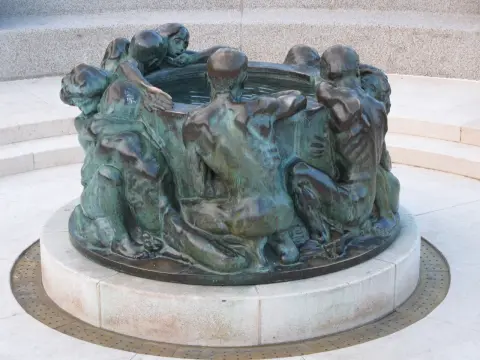
Walk through the garden. Bronze and stone figures stand among the trees, many of them women, mothers and children, or figures in prayer. Look at the hands and faces. Meštrović loved strong, simple shapes, but the emotion is always in the details, a bowed head, a gripped hand. The garden is free to sit in once you have a ticket, so take your time.
-
3
The main halls
Inside, the large halls hold works in marble, bronze and wood from across his life. Look for portraits of his family, especially his mother, a figure he returned to many times. You will also find religious works, and pieces connected to his great public monuments. Please note that the indoor exhibition rooms have been closed for renovation at times, so check what is open when you visit.
-
4
The walk to Kaštilac
Leave the villa and walk a few minutes along the road to the Kaštilac. This is a small fortified house built in the sixteenth century, at a time when this coast feared Ottoman raids. Meštrović bought it and restored it. Step into the quiet courtyard, with its loggia and stone walls. It feels like another century.
-
5
Chapel of the Holy Cross
End inside the chapel. Around the walls runs Meštrović's cycle of reliefs carved in walnut, showing the life of Christ. Above the altar hangs his crucifix. He worked on these reliefs over many years, through war and exile. Sit for a while. Many visitors find this the most moving room in all of Split.
Things you might not know
- Meštrović learned to carve as a shepherd boy before studying in Vienna.
- He donated the villa, the Kaštilac and many works to the people of Croatia in 1952.
- The Kaštilac is a sixteenth-century fortified house that Meštrović restored and turned into a chapel for his wooden reliefs.
Researched November 2026 from: mestrovic.hr, mestrovic.hr, mestrovic.hr, en.wikipedia.org. Fees and hours change, so check on the day.