⭐ Must-see · Marjan peninsula, 3 km from central Split
Marjan Forest Park
The green lungs of Split, with the sea all around
🎧 Listen to this guide · about 5 min
Pop your earphones in and we'll walk you round.
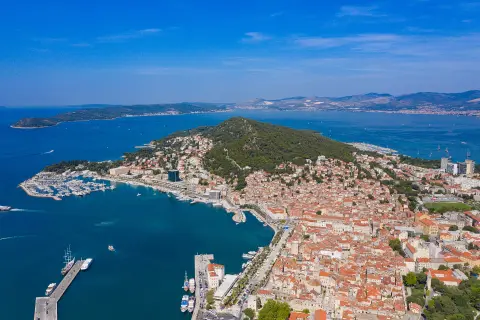
Walk ten minutes west from the palace, climb a set of stone steps, and the city falls away. Suddenly you are among pine trees. The air smells of resin and wild rosemary. Cicadas buzz in summer. Below you, the red roofs of Split spread out to the mountains, and on the other side, the islands float on the sea. This is Marjan, the hill the people of Split call the lungs of their city. They come here to run, to walk the dog, to swim from the rocks, or simply to sit on a bench and look. Today, you are going to join them.
The story of Marjan Forest Park
For centuries Marjan was a working hillside. People grazed animals here, gathered firewood and quarried stone, and by the nineteenth century much of it was bare rock. It was also a place of prayer. Small chapels were built on its slopes from the Middle Ages, and hermits lived in caves on its southern cliffs.
At the start of the twentieth century, local people decided to bring the hill back to life. A society for the care of Marjan was founded in 1903, and over the following decades volunteers and the city planted pine trees, mostly Aleppo pine, built paths and laid out viewpoints.
The forest you walk through today is largely the result of that effort. Marjan has been protected for many decades as a park forest, and it is managed by a public institution today. Locals defend it fiercely, and any plan to build on it tends to meet loud opposition.
The setting
Marjan covers most of the peninsula west of the old town. Its highest point, Telegrin, rises to about 178 metres, with a small viewpoint and a flag on top. From the Varoš neighbourhood, stone steps climb to the first terrace, the Vidilica viewpoint, with its café. From there, wide paths lead along the ridge through pine forest, past chapels, and down to the coast on the far side. The southern side drops in steep limestone cliffs, with old hermitages tucked into the rock. The northern and western shores are gentler, with pebble beaches such as Kašjuni and Bene, and a quiet coastal road loved by cyclists and runners.
Why it matters
Marjan matters because it gives a crowded, hot city a wild edge. You can swim, walk in deep shade and find total quiet within half an hour of the busiest street in Split. It is also a place of memory, with chapels, an old Jewish cemetery and hermit caves that speak of centuries of faith and community. For the people of Split, Marjan is not a tourist attraction. It is their back garden.
Your walk-through
The stops a guide would take you to, in order.
-
1
Varoš steps
Begin in Varoš, the old quarter of fishermen and farmers just west of the palace. Follow the signs to Marjan and climb the stone steps between small houses and gardens. Take it slowly. These lanes were once the home of the people who worked Marjan's slopes, and you will still see fig trees, little vegetable plots and cats asleep in doorways.
-
2
Vidilica viewpoint
At the top of the steps you reach Vidilica, the first viewpoint, with a café terrace. Turn around. Below you is the whole old town, the bell tower of the cathedral, the harbour, and behind it the mountains of the mainland. On a clear day you can see the islands of Brač and Šolta. Right beside the viewpoint is the old Jewish cemetery, a quiet place with weathered gravestones. Please visit it respectfully.
-
3
Chapel of Saint Nicholas
Continue along the path to the small stone chapel of Saint Nicholas, a simple medieval church on the slope. Saint Nicholas is the patron of sailors, and you can see why he was honoured here, looking straight out over the sea routes. Chapels like this one were built by local families and brotherhoods, not by kings. They were places to pray for a safe return.
-
4
Telegrin summit
If you have the energy, climb the final stairs to Telegrin, the highest point of Marjan, at about 178 metres. The view here is the widest of all: the city, the mountains, the islands, and the open sea to the west. It is windy, so hold onto your hat. Locals often come up just for this moment, then turn round and go home.
-
5
Saint Jerome's hermitage
Head down the southern side toward the chapel of Saint Jerome, built against the cliff. Above it, hermits once lived in caves cut into the rock. Look carefully and you will see small openings and terraces in the stone. It is a striking thought that people chose to live alone up here, with nothing but prayer, the sea and the wind.
-
6
Kašjuni or Bene beach
End your walk by the water. Follow the paths down to Kašjuni beach on the southern side, or Bene on the northern tip, both shaded by pines. The water is clear and the pebbles are smooth. Swim, rest under a tree, and then decide whether to walk back or catch a local bus or a ride into town.
Things you might not know
- Much of Marjan was bare rock in the nineteenth century; its pine forest was largely planted from the early 1900s.
- The highest point, Telegrin, is about 178 metres above sea level.
- Hermits once lived in caves in Marjan's southern cliffs near the chapel of Saint Jerome.
Researched November 2026 from: en.wikipedia.org, marjan-parkuma.hr, visitsplit.com. Fees and hours change, so check on the day.