🚗 Day trip · Island of Hvar, 50 km from central Split
Hvar Town
Venetian stone, lavender hills and a harbour full of light
🎧 Listen to this guide · about 5 min
Pop your earphones in and we'll walk you round.
As your boat turns into the harbour of Hvar, the town opens up like a stage. Stone houses climb the hillside around a long, open square. A white cathedral bell tower rises at the far end. High above, on the green hill, sits a fortress with its walls glowing in the sun. Yachts bob in the harbour, and the smell of pine and the sea fills the air. Hvar has a reputation for glamour and parties in summer, but it is also a town with a deep and remarkable history. Today we will walk through it slowly, from the waterfront to the fortress on the hill.
The story of Hvar Town
People have lived on Hvar since prehistoric times, and Greek colonists founded settlements on the island in the fourth century before Christ. The town of Hvar grew in the Middle Ages. In 1278, its people asked Venice for protection, and the town became an important base for the Venetian fleet on the Adriatic.
In 1571, an Ottoman fleet, on its way to the Battle of Lepanto, attacked and burned the town. Many people survived only by sheltering in the fortress on the hill. In 1579 lightning struck the fortress's gunpowder store and caused heavy damage, and much of the fortress you see today was built after that.
In 1612 a public theatre opened above the old Arsenal, one of the oldest surviving theatres in Europe. In 1868 the town founded the Hygienic Society of Hvar to welcome visitors for health and rest, one of the earliest tourist organisations in Europe. Tourism has shaped Hvar ever since.
The setting
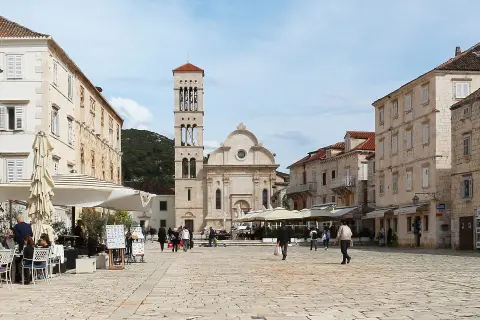
Hvar Town lies on the southwest side of the long, narrow island of Hvar, in a sheltered bay facing the small Pakleni islands. The heart of the town is the main square, the Pjaca, about 4,500 square metres, said to be the largest in Dalmatia. At its eastern end stands Saint Stephen's Cathedral. On the harbour side is the Arsenal, where Venetian galleys were repaired, with the theatre above. Stone lanes climb the slopes on both sides of the square. North of the town, a path zigzags up through pines and agaves to the hilltop fortress, Fortica. To the east along the shore sits the Franciscan monastery.
Why it matters
Hvar is a near-complete Venetian-era town, with its square, cathedral, arsenal, theatre and fortress all still standing. Its theatre is a rare survivor from the early seventeenth century, when public theatres open to all classes were very unusual. Its early tourism society makes it a pioneer of travel in Europe. Today it balances its fame as a summer resort with its role as a living island town.
Your walk-through
The stops a guide would take you to, in order.
-
1
The harbour and the Arsenal
Start on the harbour front by the Arsenal, the large stone building with a wide arch facing the sea. Venetian war galleys were sheltered and repaired here. Look up. Above the Arsenal is the theatre, opened in 1612. In a time when theatre was usually for nobles at court, this one was open to the public. That made it quite revolutionary.
-
2
The Pjaca
Step into the Pjaca, the main square. It is wide, bright and paved with smooth white stone, polished by centuries of footsteps. It is said to be the largest square in Dalmatia. Look around at the Venetian-style buildings and the old well in the middle. In the evenings, this is where the whole town gathers.
-
3
Saint Stephen's Cathedral
Walk to the eastern end of the square to Saint Stephen's Cathedral, with its tall, elegant bell tower. The building as you see it took shape mainly in the late Renaissance, after the Ottoman attack of 1571. Step inside to see its altars and paintings. If it is closed, admire the façade and the way the bell tower grows lighter as it rises.
-
4
The climb to Fortica
Now climb. Follow the stepped lanes north through the old town and up the path through the park of pines and agave. It is a steady 20 to 30 minute walk. Stop to catch your breath and look down. The roofs of the town, the harbour and the Pakleni islands open up below you. It is one of the finest views in Dalmatia.
-
5
Fortica fortress
At the top is Fortica, also called the Spanish Fortress. Much of it was built after lightning struck the gunpowder store in 1579. In 1571, the townspeople sheltered here while the Ottoman fleet burned the town below. Walk the walls and look out to sea. This is where Hvar watched for danger for centuries.
-
6
Franciscan monastery
Finish your day back by the sea, with a walk east along the shore to the Franciscan monastery of Our Lady of Grace. Its cloister is calm and shaded, and its small museum holds paintings and old books. The garden sits right beside the water. It is the perfect quiet ending before the boat back to Split.
Things you might not know
- The Hvar theatre opened in 1612 and is one of the oldest surviving public theatres in Europe.
- The Hygienic Society of Hvar, founded in 1868, was one of the earliest tourist organisations in Europe.
- Hvar's main square covers about 4,500 square metres, said to be the largest in Dalmatia.
Researched November 2026 from: en.wikipedia.org, visithvar.hr, jadrolinija.hr. Fees and hours change, so check on the day.