⭐ Must-see · Santa Cruz, 1 km from central Seville
Real Alcázar of Seville
A thousand years of kings, carved plaster and orange-scented gardens
🎧 Listen to this guide · about 6 min
Pop your earphones in and we'll walk you round.
Welcome to the Real Alcázar. Step through the red Lion Gate and the noise of the city simply falls away. In front of you lies a palace that has been growing for more than a thousand years. Caliphs, Christian kings and emperors have all walked these courtyards. Each one added a hall, a garden or a fountain, and somehow it all fits together. You will see plaster carved as fine as lace, tiles in every colour of the kiln, and ceilings that glow like the inside of a jewel box. Then the gardens open up, full of palms, orange trees and quiet pools. Take your time here. The Alcázar rewards a slow walk and a curious eye, so let's begin.
The story of Real Alcázar of Seville
The story starts in the early tenth century, when the rulers of al-Andalus built a fortified governor's palace on this spot. Over the next centuries the Abbadid kings and then the Almohads, who ruled from North Africa, enlarged it into a walled palace city. In 1248 Ferdinand III of Castile took Seville, and the Christian kings moved in. They kept what they liked and began to build their own halls.
The biggest change came under Pedro I of Castile in the 1360s. He brought in craftsmen from Granada, Toledo and Seville to build a new palace in the Mudéjar style, Islamic in look but made for a Christian king. An inscription in the palace dates the work to 1364. Later rulers kept adding. Isabella and Ferdinand set up the Casa de Contratación here in 1503 to run trade with the Americas, and the Emperor Charles V married Isabella of Portugal in the palace in 1526.
In 1987 UNESCO listed the Alcázar as a World Heritage Site, together with the cathedral next door and the Archive of the Indies. Its upper rooms remain an official residence of the Spanish royal family, which makes it one of the oldest royal palaces in Europe still in use.
The setting
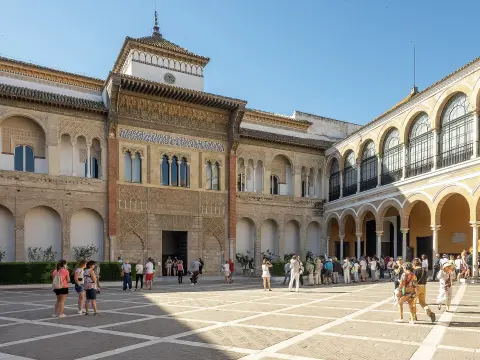
The Alcázar sits at the southern edge of the old town, beside the cathedral, behind high crenellated walls. You enter through the Puerta del León, the Lion Gate, into the Patio del León, and then the Courtyard of the Hunt, with Pedro I's palace facade straight ahead. The layout is a chain of courtyards and halls, each opening into the next, so the light changes with every doorway. Beyond the palaces spread the gardens, covering several hectares. There are formal terraces with box hedges, tiled benches, fountains, a long gallery built on the old city wall, and wilder corners with tall palms and peacocks. Underneath it all, cool vaulted baths hold still water. The whole site is flat and easy to walk, though the gravel paths can be dusty in summer.
Why it matters
The Alcázar shows, better than almost any building in Spain, how Islamic and Christian traditions mixed in medieval Andalusia. Pedro I wanted his palace to look like the best Islamic work of his day, and the result is a Christian king's home covered in Arabic script and geometric tile. Today it is also a working palace and a cultural centre, with concerts in the gardens in summer. Film crews love it too. Its gardens stood in for the Water Gardens of Dorne in Game of Thrones. Most of all, it is a place where you can feel Seville's layered history in one walk.
Your walk-through
The stops a guide would take you to, in order.
-
1
Facade of the Palace of Pedro I
Across the Courtyard of the Hunt stands the face of Pedro I's palace. Look closely at the band of writing near the top. One inscription is in Gothic letters, praising the king of Castile who built it. Another is in Arabic script, repeating a phrase used in the Nasrid palaces of Granada. A Christian king chose Islamic art to show his power. That mix is the heart of the Mudéjar style, and you will see it everywhere inside.
-
2
Patio de las Doncellas
This is the Courtyard of the Maidens, the formal heart of the palace. A long, sunken pool runs down the middle, flanked by sunken gardens that were uncovered and restored in the early 2000s. Around you, arches of carved plaster rest on slender columns. The upper gallery is Renaissance, added in the sixteenth century, so you can see two worlds stacked one on top of the other. Legend links the name to tribute once paid in young women, but historians treat that as a tale.
-
3
Salón de Embajadores
Now the Hall of the Ambassadors, the most dazzling room in the palace. Look up. The golden wooden dome was made in the fifteenth century, carved and gilded so it seems to spin like a star. Below it, the walls are covered with tiles and plasterwork in endless patterns. This was the throne room, where the king received visitors. Charles V's wedding celebrations took place in these rooms. Stand in the middle, turn slowly, and let your eyes adjust to all that gold.
-
4
Baños de Doña María de Padilla
Head down into these vaulted chambers under the Gothic palace. They are really rainwater tanks that cooled the gardens above, not baths at all. A long pool reflects the ribbed vaults, and the air is cool even on hot days. They take their name from María de Padilla, the woman Pedro I loved. So the story goes, she bathed here, and courtiers drank the water to win her favour. It is a lovely tale, though there is no proof for it.
-
5
Gardens and Galería del Grutesco
End in the gardens. Walk to the Galería del Grutesco, a long gallery built over an old Islamic wall and decorated with rough, cave-like stonework. Climb up if it is open and look out over the hedges, fountains and palms. Below you is the Mercury Pool, with a bronze statue of the messenger god. Peacocks often wander the paths. Find a tiled bench in the shade, listen to the water, and you will understand why kings never wanted to leave.
Things you might not know
- UNESCO listed the Alcázar in 1987 together with Seville Cathedral and the Archive of the Indies.
- The upper floor of the palace is still an official residence of the Spanish royal family.
- The Casa de Contratación, which controlled Spain's trade with the Americas, was founded inside the Alcázar in 1503.
Researched November 2026 from: alcazarsevilla.org, whc.unesco.org, en.wikipedia.org. Fees and hours change, so check on the day.