💎 Hidden gem · Lands End, Outer Richmond, 11 km from central San Francisco
Sutro Baths Ruins
Crashing surf among the walls of a vanished palace
🎧 Listen to this guide · about 6 min
Pop your earphones in and we'll walk you round.
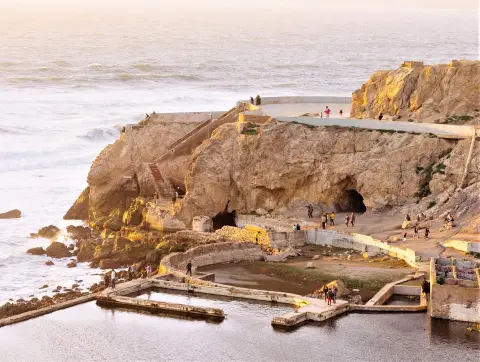
Welcome to Lands End, the wild western edge of San Francisco. Below us, at the foot of these cliffs, lie the ruins of the Sutro Baths. Once a glass palace stood here, filled with pools, slides and thousands of swimmers. Now only concrete walls and flooded basins remain, and the Pacific rushes in through the gaps. Cormorants dry their wings on the rocks. Fog drifts across the water. It feels far from the city, though you are still inside it. This is a place locals love for sunset walks and quiet thinking. We will walk down to the ruins, peer into a sea cave, and then climb back up for views of the Golden Gate.
The story of Sutro Baths Ruins
The baths were the dream of Adolph Sutro, a German-born engineer who had grown rich from a tunnel that drained the silver mines of Nevada. He bought much of the land at this end of the city, including the Cliff House above the beach, and he built his own estate on the heights nearby. Sutro later served as mayor of San Francisco from 1895 to 1897.
The Sutro Baths opened to the public on 14 March 1896. They were billed as the world's largest indoor swimming establishment. Under a vast roof of glass and iron there were six saltwater pools and one freshwater pool, holding about 1.8 million gallons. High tides refilled the pools with ocean water. There were slides, trapezes, springboards, a museum of curiosities and seats for spectators. Sutro kept the price low so ordinary families could come by streetcar from across the city.
The baths were expensive to run, and over the years attendance fell. In 1952 a new owner, George Whitney, closed part of the building and later shut the pools. In 1964 developers bought the site to build apartments. In 1966, while the building was being demolished, a fire destroyed what remained, and investigators concluded it was arson. The apartments were never built. Today the ruins are part of the Golden Gate National Recreation Area, run by the National Park Service.
The setting
The ruins sit in a rocky cove at the north end of Ocean Beach, below Point Lobos Avenue. From the Lands End Lookout visitor centre, a path and stairs lead down the slope to the old foundations. You will see the outlines of the pools, now filled with rainwater and seawater, divided by concrete walls you can walk along with care. On the north side of the cove a short tunnel cuts through the rock, and inside it a deep crevice lets you hear waves pounding below. Above, the Lands End Trail runs north along the cliffs through cypress trees, with views across the strait to the Marin Headlands.
Why it matters
The Sutro Baths remind us of a time when grand public pleasures were built for everyone, not only the wealthy. Now they are a protected public place again, part of a national park inside a city. For locals, Lands End is a place to escape crowds, watch birds and see the ocean in all its moods. The ruins also show how quickly the Pacific reclaims what people build at its edge. Learning the story here also helps you see how San Francisco's coast has always been a place for public leisure.
Your walk-through
The stops a guide would take you to, in order.
-
1
Lands End Lookout
Begin at the Lands End Lookout visitor centre on Point Lobos Avenue. Inside are photographs and exhibits about the baths and the Sutro family. From the terrace outside, look down at the ruins in the cove below. It helps to compare the old photographs with what you see now, so you can picture the glass roof that once covered all of this.
-
2
Stairs down to the pools
Take the path and stairs down toward the ruins. As you go, you will pass old foundations half hidden by ice plant and coastal scrub. At the bottom, the outlines of the pools open out in front of you. Some walls are wide enough to walk on, but they can be slippery and the drops are real. Stay on stable ground and keep away from the edges when waves are high.
-
3
The ocean inlet
Walk toward the western wall, where the ocean meets the ruins. This is where tidewater once flowed in through channels to fill the pools. Now the waves surge in freely and spray over the concrete. Watch the rocks offshore for cormorants and pelicans. Never climb out onto the rocks here. The waves at Lands End are powerful and unpredictable.
-
4
The sea cave tunnel
On the north side of the cove, find the short tunnel through the cliff. Step inside and let your eyes adjust. In the middle, a deep crack opens to the sea, and with each wave you hear a boom and feel the air move. At the far end you look out at the open ocean. It is a powerful spot, best visited at low tide and calm weather.
-
5
Point Lobos overlook
Climb back up and follow signs to the overlook at Point Lobos. From here you can see the whole cove, Seal Rocks offshore and the long sweep of Ocean Beach to the south. On clear days the Farallon Islands appear on the horizon, about thirty miles out. This is one of the best places in the city to watch the sun go down over the Pacific.
-
6
Lands End Trail
If you have time, walk north along the Lands End Trail through the cypress trees. The path follows the cliffs toward the Golden Gate, and soon the bridge appears framed between branches. Watch for side paths down to small beaches and viewpoints. The trail is well maintained but has steps and steep sections, so take it at your own pace.
Things you might not know
- The Sutro Baths held six saltwater pools and one freshwater pool under a glass roof.
- Ocean tides were used to help refill the pools.
- The building burned in 1966 while being demolished, and the planned apartments were never built.
Researched November 2026 from: en.wikipedia.org, nps.gov, nps.gov. Fees and hours change, so check on the day.