⭐ Must-see · Morzg, southern Salzburg, 6 km from central Salzburg
Hellbrunn Palace and Trick Fountains
A prince's playground, where the water still has the last laugh
🎧 Listen to this guide · about 6 min
Pop your earphones in and we'll walk you round.
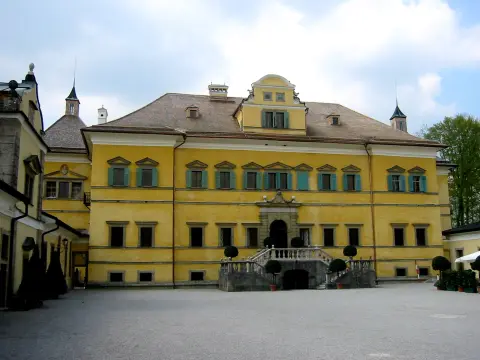
Welcome to Hellbrunn, the happiest place a prince-archbishop ever built. It sits on the southern edge of the city, at the foot of a wooded hill, surrounded by a broad park. The palace is graceful and pale yellow. But we are really here for the water. Hidden in the gardens are grottoes, statues and pipes, all fed by natural springs, and all designed to surprise you. Seats squirt. Statues spit. Little figures move to music. Stay close to the guide and watch where they stand. When they step back, you should too. People have been laughing in this garden since the early seventeenth century, and today it is your turn.
The story of Hellbrunn Palace and Trick Fountains
Hellbrunn was built from 1613 to 1619 for Prince-Archbishop Markus Sittikus von Hohenems. He was a cultured man who had spent time in Italy, and he wanted a villa in the Italian style for summer days. The name means clear spring, after the water that rises here. It was a day residence, for parties and pleasure, so it was built without a bedroom. The archbishop rode back to the city each night.
Sittikus loved jokes, and the trick fountains were his great amusement. Guests at his stone dinner table would suddenly be sprayed from their seats, while the archbishop's chair stayed dry. Nobody could leave the table before the host, so all they could do was laugh.
Later archbishops added to the gardens. In 1750 a water-powered mechanical theatre was installed, with around two hundred small moving figures showing a baroque town at work. In the park, Sittikus also had a small summer house, the Monatsschlössl, built on the hill. Tradition says it went up in a single month. The estate passed to the state in the nineteenth century and opened fully to the public.
The setting
Hellbrunn lies about six kilometres south of the Old Town, at the end of a long tree-lined avenue. The palace faces a formal courtyard and garden. Behind it, the trick fountains are spread through a series of grottoes and outdoor spaces, fed by springs from the Hellbrunn hill. Beyond stretches a large landscape park with ponds, meadows and old trees. On the wooded hill above stand the Monatsschlössl, now a folk museum, and a stone theatre cut into an old quarry. Salzburg Zoo lies next door. The glass pavilion from The Sound of Music now stands in the park as well.
Why it matters
Hellbrunn is one of the finest surviving Mannerist and early baroque pleasure gardens in Europe, and its trick fountains still work as they were meant to, powered only by water. It shows the lighter side of the prince-archbishops, men who held real power but also loved art, music and games. It is also one of the earliest places north of the Alps where opera was staged. For families today it is pure joy, and for garden lovers a rare survival from four centuries ago.
Your walk-through
The stops a guide would take you to, in order.
-
1
The Roman theatre and Prince's Table
The tour begins at a stone table with stone stools in a small open-air theatre. This was where Markus Sittikus dined with his guests. Look at the little holes in the seats. At a signal, water shot up from every stool except one: the archbishop's own. The guests got soaked, and etiquette kept them in their places. Watch the guide's hand. Then decide where you want to stand.
-
2
The grottoes
Next come the grottoes, cool and shadowy, lined with shells and stones. Water runs everywhere, along walls and through hidden pipes. In one, birds seem to sing; their voices are made by water pushing air through whistles. In another, jets spring from the floor without warning. These rooms were meant to feel like a world under the sea. Keep your camera ready, and keep it dry.
-
3
The Crown Grotto
Here a golden crown sits on a jet of water. As the pressure rises, the crown lifts up. As it falls, the crown sinks down again. It was meant as a lesson about power, which rises and falls like water. Under the bright spray it looks like a game. But remember that the archbishop who built it, and the one before him, both knew how quickly fortunes can change.
-
4
The Mechanical Theatre
Now to the masterpiece, built in 1750. Behind a glass front, a whole baroque town comes to life. About two hundred little wooden figures go about their work. Butchers chop, a baker bakes, soldiers march, a dancing bear turns. All of it is driven by water, and an organ powered by water plays as they move. Stand close and pick out your favourite. Every visitor finds a different one.
-
5
The palace interior
Leave the fountains and walk into the palace itself. The rooms are painted with bright frescoes in the Italian style, including a fine banqueting hall and an octagonal music room with a painted ceiling. This was a house for entertainment, not for sleep. Imagine summer evenings here, windows open, music drifting into the gardens and the sound of fountains outside.
-
6
The park and the Sound of Music pavilion
Finally, stroll into the park. Follow the paths past ponds and old trees. You will find the glass pavilion from The Sound of Music, where Liesl and Rolf sang Sixteen Going on Seventeen. It was moved here from its film location. If you have energy, climb the hill to the Monatsschlössl and its folk museum, and the stone theatre in the old quarry nearby.
Things you might not know
- Hellbrunn was built only as a day residence, so it has no bedroom.
- The mechanical theatre from 1750 has around two hundred moving figures, all powered by water.
- Tradition says the Monatsschlössl on the hill was built within a single month.
Researched November 2026 from: en.wikipedia.org, hellbrunn.at, salzburg.info. Fees and hours change, so check on the day.