⭐ Must-see · Mykonos Town, near the Old Port
Archaeological Museum of Mykonos
The Trojan Horse, the graves of Delos and Mykonos before the beaches
🎧 Listen to this guide · about 5 min
Pop your earphones in and we'll walk you round.
Step out of the sunshine and into the cool rooms of the Archaeological Museum. Most people come to Mykonos for the sea and the nightlife, and they walk straight past this building by the harbour. That is their loss. Inside are pots, jewellery, grave markers and sculpture that tell the story of these islands thousands of years before the first tourist arrived. And there is one object that people travel across the world to see: a huge clay storage jar, taller than a child, covered in scenes from the fall of Troy. On it you will find the Trojan Horse itself, with Greek warriors peering out of little windows in its side. Let's go and meet it.
The story of Archaeological Museum of Mykonos
The museum was planned at the end of the nineteenth century. In 1898 the town of Mykonos gave the state a plot of land on the low hill above the harbour, and construction began in 1899. It opened in the early twentieth century, making it one of the oldest purpose-built museums in Greece.
It was created to hold a remarkable find. In ancient times the sacred island of Delos had to be kept pure. Around 426 to 425 BC the Athenians ordered that all the graves on Delos be opened, and the bones and grave goods were carried across to the neighbouring island of Rheneia. There they were placed in a large pit, which archaeologists call the Purification Pit. It was excavated in 1897, and its contents, thousands of pots and offerings, came here.
Over the years the museum also took in finds from Mykonos itself, from ancient settlements and graves around the island. The star of the collection, the relief pithos of Mykonos, dates to the seventh century BC. It was found in Mykonos Town in 1961 and has been on show here since.
The setting
The museum is a neoclassical building on the slope above the harbour, at Kaminaki on the northern edge of town. It is modest in size, with a handful of rooms around a central space. The rooms are bright and simply laid out, with cases of pottery arranged by period. Many pieces come from Rheneia, so you see vases of many shapes and styles, from geometric patterns to black-figure scenes. Grave reliefs and small sculptures stand along the walls. The great pithos has a room of its own, placed so you can walk around it and study the panels. From the front steps you look out across the harbour where ferries and fishing boats come and go.
Why it matters
The museum gives Mykonos a deep past. It reminds visitors that this was part of the sacred world around Delos, one of the most important religious centres of ancient Greece. The Rheneia finds are a rare record of grave goods from many centuries, gathered in one place. And the pithos is precious for anyone who loves Homer's stories. Its Trojan Horse is among the earliest known images of the legend, showing that the tale was already told and illustrated in the seventh century BC.
Your walk-through
The stops a guide would take you to, in order.
-
1
The front steps and harbour view
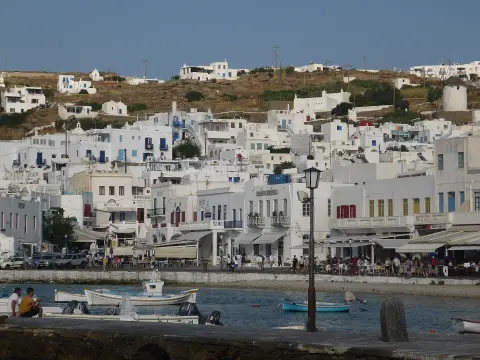
Before you go in, turn around on the steps. Below you is the harbour of Mykonos. Delos lies just beyond the headland to the southwest. In ancient times, boats crossed between these islands constantly. Keep that link in mind, because much of what you will see inside came from those sacred waters.
-
2
The Rheneia pottery rooms
Walk into the first rooms and look at the rows of vases. Many of them come from the Purification Pit on Rheneia. They were once buried with the dead on Delos, then dug up and moved by order of Athens around 426 BC. Look at the shapes: tall jugs, shallow cups, little oil flasks. Each was once part of a family's farewell to someone they loved.
-
3
Grave reliefs and sculpture
Now look at the carved stone grave markers. You will see figures saying goodbye, often clasping hands. These scenes are calm and gentle, not dramatic. The ancient Greeks often showed death as a quiet parting. Stand in front of one and look at the faces. The feeling is easy to understand even after more than two thousand years.
-
4
The Mykonos pithos
Here is the great jar. It was made in the seventh century BC to store grain or oil, and later used for a burial. On its neck you see the Trojan Horse, on wheels, with small square windows. Inside, the heads of Greek warriors look out. Some are already climbing down. This is one of the oldest pictures of the horse anywhere.
-
5
The panels of the fall of Troy
Walk around the body of the jar. The panels show the cruel side of the story: the killing of women and children after the city fell. There is a scene often read as Menelaus finding Helen. The artist did not soften the war. It is powerful to see how early Greek craftsmen told this story, with no glory, only grief.
Things you might not know
- Construction of the museum began in 1899, on land given by the town in 1898.
- Many exhibits come from the Purification Pit on Rheneia, where graves from Delos were moved around 426–425 BC.
- The seventh-century BC Mykonos pithos carries one of the earliest known depictions of the Trojan Horse.
Researched November 2026 from: cyclades.culture.gov.gr, cyclades.culture.gov.gr, mykonos.gr. Fees and hours change, so check on the day.