⭐ Must-see · Altstadt
Marienplatz and the New Town Hall Glockenspiel
Bells, dancing coopers and the old heart of Munich
🎧 Listen to this guide · about 7 min
Pop your earphones in and we'll walk you round.
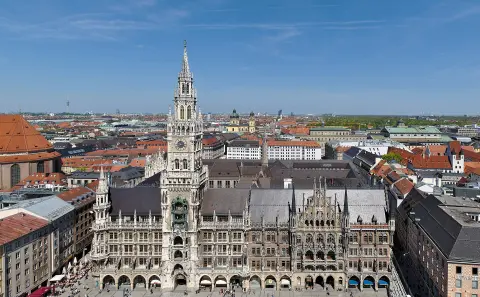
Welcome to Marienplatz, the square where Munich has met, traded and celebrated for more than eight hundred years. Stand still for a moment and look up. The grey stone face of the New Town Hall rises above you, all spires, gargoyles and carved saints. High on its tower, behind little balconies, a crowd of painted figures waits for its cue. At eleven and at noon the bells begin, and the whole square turns its head. Around you, the city goes about its day. Shoppers stream in from the pedestrian streets, a street musician tunes up, and the twin onion domes of the cathedral peek over the rooftops. This is where Munich feels most like itself. Let's take it slowly, and I'll show you the stories hiding in plain sight.
The story of Marienplatz and the New Town Hall Glockenspiel
Munich began as a market settlement on the salt road, and this square was its market from the start. For centuries it was simply the Schrannenplatz, the grain market, where farmers sold their harvests. In 1638, during the Thirty Years' War, Elector Maximilian I raised a column to the Virgin Mary in thanks that the city had been spared destruction when Swedish troops occupied it in 1632. In 1854 the square was renamed Marienplatz after her.
The New Town Hall came much later. As Munich grew in the nineteenth century, the old council house at the eastern end was too small. The young architect Georg von Hauberrisser won the commission, and the building rose in stages between 1867 and 1908. He chose a neo-Gothic style, borrowing from Flemish town halls, to give the city a proud, medieval-looking seat of government.
The Glockenspiel was installed in the tower in 1908. Its upper tier recalls the wedding of Duke Wilhelm V and Renata of Lorraine in 1568, with a jousting match in which the Bavarian knight always wins. The lower tier shows the Schäfflertanz, the coopers' dance. Tradition says the barrel makers first danced it in 1517 to coax frightened people back onto the streets after a plague. Munich was heavily bombed in the Second World War, but the town hall survived with damage and was restored.
The setting
Marienplatz is a broad, paved rectangle in the middle of the Altstadt, closed to traffic and busy with people from morning until late. The New Town Hall fills the whole northern side, a long facade nearly a hundred metres wide, crowned by a tower about 85 metres high. Its stone is dark and richly carved, with dukes, kings and saints of Bavarian history lined up along the front. At the eastern end stands the Old Town Hall, a pale fifteenth-century building with a stepped gable and a slender tower. The Marian Column stands near the centre, a golden Virgin on top. The Fish Fountain sits close to the town hall entrance. Narrow streets lead off on every side, to the Viktualienmarkt food market, to St Peter's Church and to the cathedral.
Why it matters
This square is still the stage for Munich's big moments. Football champions celebrate on the town hall balcony. The Christmas market fills the square each Advent, with stalls under the Gothic facade. The city council still meets inside the New Town Hall, so this is a working building, not a museum piece. For visitors, Marienplatz is also the easiest place to understand the shape of Munich. From here the old town unfolds in every direction, and the Glockenspiel ties the present to customs that locals still keep, such as the coopers' dance, which is performed in the streets roughly every seven years.
Your walk-through
The stops a guide would take you to, in order.
-
1
The Marian Column
Start at the centre with the Mariensäule. The golden Virgin on top was raised in 1638. Now look at the base. Four little armoured cherubs are fighting four beasts. Each beast stands for a disaster the city feared: plague, war, hunger and heresy. It was a prayer in stone, made in the middle of a long and terrible war. Locals often use the column as a meeting point, so if you lose the group later, this is where to find me.
-
2
The Glockenspiel
Now turn to the tower and find the two rows of figures behind the oriel. There are 43 bells and 32 life-size figures. On the top tier the wedding guests parade and two knights joust. Below, the coopers dance in a ring with their hoops. The show lasts around twelve to fifteen minutes. At the very end a small golden rooster at the top flaps its wings and crows three times. Watch for it, because many people leave too early and miss it.
-
3
New Town Hall facade and courtyard
Walk closer to the facade and look at the carvings. You will find rulers of Bavaria, saints, and some cheeky little details, including a dragon winding around the corner on the Weinstrasse side. Step through the main gate into the inner courtyard. It is quieter here, with arcades and a few cafes. Hauberrisser built the town hall over forty years, and you can see the change in style between the older eastern part and the grander front.
-
4
The town hall tower
If you have a head for heights, a lift takes you most of the way up the tower to a viewing platform. Tickets are sold for timed slots at the tourist office on the ground floor. From the top you look straight down on the square and across red roofs to the cathedral's twin domes. On a clear day, especially in autumn with a warm Föhn wind, the Alps line the southern horizon. It is a short visit, but it explains the city in one glance.
-
5
The Fish Fountain
Back down, find the Fischbrunnen near the town hall entrance. In the Middle Ages, butchers' apprentices were plunged into the fountain here to mark the end of their training. Today there is a gentler custom. On Ash Wednesday, the mayor and townspeople come to wash their empty purses in the water. Tradition says it brings money back in the year ahead. It is a funny little ritual, and it tells you a lot about Munich's humour.
-
6
The Old Town Hall
End at the eastern side with the Old Town Hall. It dates from the fifteenth century and was rebuilt after wartime damage. Its great hall was where the city held its feasts and dances. On the night of 9 November 1938, Joseph Goebbels gave a speech here that set off the pogrom against Jewish people across Germany. It is a sober thing to remember on such a pretty square. Today the tower houses a small toy museum, a gentler use for an old building.
Things you might not know
- The Glockenspiel has 43 bells and 32 life-size figures, and has played since 1908.
- The square was called the Schrannenplatz, or grain market, until it was renamed Marienplatz in 1854.
- A small golden rooster crows three times to close each Glockenspiel show.
Researched November 2026 from: muenchen.de, muenchen.de, munich.travel, en.wikipedia.org. Fees and hours change, so check on the day.