⭐ Must-see · Corso Magenta, 2 km from central Milan
Santa Maria delle Grazie and Leonardo's Last Supper
Fifteen minutes with Leonardo, in the monks' dining hall
🎧 Listen to this guide · about 6 min
Pop your earphones in and we'll walk you round.
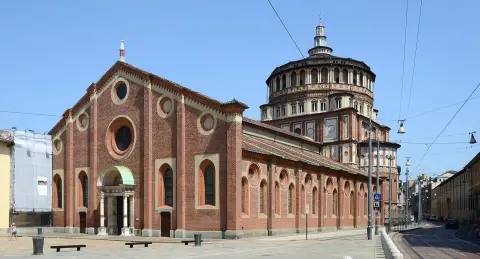
Here we are on Corso Magenta, in front of a church of warm red brick with a round, many-sided dome. It looks modest from the street. But behind it, in what was once the monks' dining hall, is a painting that people cross oceans to see: Leonardo da Vinci's Last Supper. Your visit inside is short, only fifteen minutes, and the group is small. So let me prepare you now. You will walk through a series of glass doors that keep the air clean and still. Then the door opens, and there it is, filling the end wall. Don't rush to take photos. Just look. Notice the hands. Leonardo told the whole story through them.
The story of Santa Maria delle Grazie and Leonardo's Last Supper
The church of Santa Maria delle Grazie was built for the Dominican friars in the second half of the fifteenth century, from 1463. Soon after, the Duke of Milan, Ludovico Sforza, chose it as the family's burial church. He had the east end rebuilt in a grand new style, perhaps to plans by Donato Bramante, and he asked Leonardo da Vinci to paint the end wall of the friars' refectory.
Leonardo worked on it from about 1495 to 1498. He did not paint a true fresco, which must be done quickly on wet plaster. Instead he painted in tempera on a dry wall, so he could work slowly and change his mind. It gave him richer colour and subtle detail, but the paint soon began to flake. Within decades, visitors already described it as damaged. In 1652 the friars even cut a doorway through the lower centre, removing Christ's feet.
Then came war. On 15 August 1943 Allied bombs struck the refectory and brought down part of the room. The painting survived, protected by sandbags and scaffolding. After many earlier restorations, a great final campaign led by Pinin Brambilla Barcilon ran from 1978 to 1999, removing old repaints and revealing what remains of Leonardo's own hand. Together with the church, the painting was listed by UNESCO as a World Heritage Site in 1980.
The setting
The church faces a small square on Corso Magenta, a short walk west of the old centre. The front half is late Gothic in Lombard brick, with round windows and terracotta trim. The eastern end, the tribune, is lighter and more geometric, a Renaissance cube topped by a sixteen-sided drum. Beside the church lies a small cloister, and on the far side, entered separately from the square, is the refectory. It is a long, plain hall with a high vaulted ceiling. The Last Supper covers the north end wall, about eight and a half metres wide. Facing it, across the room, is a large Crucifixion painted in 1495 by Giovanni Donato da Montorfano.
Why it matters
The Last Supper changed the way artists told stories in paint. Instead of a calm row of saints, Leonardo caught a single dramatic instant, the moment after Jesus says one of the twelve will betray him, and showed each apostle reacting in his own way. Its perspective, its grouping of figures in threes, and its sense of human emotion have been studied and copied for five centuries. Today it is also a lesson in conservation. Every visit is timed and every group is small, because the breath and warmth of visitors matter to a wall this fragile.
Your walk-through
The stops a guide would take you to, in order.
-
1
The square and the brick facade
Start outside and look at the church as a whole. The front is earlier, late Gothic, in red brick with terracotta decoration. Then follow the side wall toward the back and see how the style changes. The great domed end was built for Ludovico Sforza, who wanted a grand family mausoleum. His wife, Beatrice d'Este, was buried here in 1497. Their tomb figures were later moved to the Certosa of Pavia, which you can visit on a day trip.
-
2
The church interior and the tribune
If there is time before your slot, step into the church. It is free. Walk up the nave, with its painted arches, to the tribune at the far end. Look up into the dome. The light and clean geometry feel very different from the Gothic nave. Off to one side, the small cloister is a peaceful place to sit, with its garden and colonnade. It helps you imagine the daily life of the friars.
-
3
The filtered entrance
Now for the refectory. You pass through a series of glass chambers, waiting a minute or two in each while the air is filtered and the humidity steadies. It may feel slow. It is part of what keeps the painting alive. Use the pause to remember: what you are about to see is not a fresco but tempera on dry plaster, which is why it flaked so badly, and why every restoration has been such delicate work.
-
4
The Last Supper
And here it is. Stand in the middle of the room first, then move closer. Jesus sits in the centre, calm, framed by the window behind him, his arms forming a triangle. The apostles recoil in groups of three. Peter leans in with a knife in his hand. Judas pulls back into shadow, clutching a small bag. Look at the empty space beside Jesus, and at the hands everywhere, pointing, protesting, asking. Notice too the arched gap at the bottom centre where the doorway was cut in 1652.
-
5
Montorfano's Crucifixion
Before your time is up, turn around. On the opposite wall is a large, crowded Crucifixion by Giovanni Donato da Montorfano, finished in 1495, painted as a true fresco and much better preserved. In the lower corners, Leonardo added portraits of Ludovico Sforza, his wife and their children, painted in tempera. They have almost vanished, ghostly shapes on the wall. They show how fragile his method was, side by side with Montorfano's sturdy fresco.
Things you might not know
- The painting measures about 4.6 by 8.8 metres.
- In 1652 a doorway was cut through the bottom of the painting, removing Christ's feet.
- Visits last fifteen minutes, with at most forty people in the room at a time.
Researched November 2026 from: cenacolovinciano.org, en.wikipedia.org, whc.unesco.org. Fees and hours change, so check on the day.