⭐ Must-see · Little Havana, Miami, 4 km from central Miami
Little Havana and Calle Ocho
Strong coffee, clicking dominoes and the music of exile
🎧 Listen to this guide · about 5 min
Pop your earphones in and we'll walk you round.
Bienvenidos to Little Havana. Listen for a moment. Dominoes slapping onto tables. Spanish drifting out of shop doors. A little salsa from a passing car. Smell that? Cuban coffee, sweet and strong, sold through small street windows called ventanitas. We are standing on Calle Ocho, SW 8th Street, the spine of the most famous Cuban neighbourhood outside Cuba. For many families here, this street was the first place they felt safe after leaving home. We will walk a short, rich stretch together, with a stop for coffee, a peek into an old cinema, and a visit to the park where the grandfathers of Miami play.
The story of Little Havana and Calle Ocho
Before it was Little Havana, this area west of downtown was known as Riverside and Shenandoah. In the 1930s it was a lower-middle-class neighbourhood with a strong Jewish community, along with many white Southern families.
Everything changed after the Cuban Revolution of 1959. Wave after wave of Cubans arrived in Miami, many of them fleeing Fidel Castro's government, and many settled here because rents were low and it was close to downtown jobs. By the 1960s people were calling it Little Havana. By 1970, more than 85 per cent of residents were Cuban. Later arrivals, including those of the Mariel boatlift in 1980, and immigrants from Nicaragua, Honduras and elsewhere in Latin America, added new layers.
The neighbourhood became the political and cultural heart of Cuban America. Exile groups met in its cafés, monuments to Cuba's heroes rose along its boulevards, and the Calle Ocho festival grew into one of the largest street parties in the country. In 2015 the National Trust for Historic Preservation listed Little Havana among America's most endangered historic places, and in 2017 it declared the neighbourhood a National Treasure.
The setting
Little Havana sits just west of downtown Miami and south of the Miami River. The busiest stretch for visitors runs along SW 8th Street from about 12th Avenue to 17th Avenue. It is a flat, walkable grid of one- and two-storey buildings, many painted in bright colours, with murals of roosters, musicians and Cuban landscapes. Calle Ocho is a busy road, part of the old Tamiami Trail that runs all the way across the Everglades to the Gulf coast. Small cigar shops, fruit stands, music bars, botánicas and bakeries crowd the pavements. Leafy SW 13th Avenue, known as Cuban Memorial Boulevard, crosses Calle Ocho with a line of monuments.
Why it matters
Little Havana is where Miami became a bilingual, Latin American city. The Cuban exile community that grew here shaped local politics, business, music and food across South Florida. For Cuban Americans it is still a place of memory, where people gather to celebrate, to protest, and to mourn news from the island. It also tells a wider story about immigration in the United States, and about how a neighbourhood can hold on to its identity while new arrivals, and new visitors, keep changing it.
Your walk-through
The stops a guide would take you to, in order.
-
1
Cuban Memorial Boulevard, SW 13th Avenue
Begin under the trees on this quiet boulevard. Walk slowly past the monuments. The most important is the memorial to the Bay of Pigs invasion of April 1961, with its eternal flame, honouring the exile brigade that tried to overthrow Castro's government. There are also monuments to José Martí and to the Virgin of Charity, Cuba's patron saint. People here speak of these events with deep feeling, so take your time and be respectful.
-
2
A ventanita coffee window
Now walk up to Calle Ocho and find a ventanita, a little walk-up coffee window. Order a cafecito, a tiny cup of sweet espresso, or a colada, a larger cup meant to be poured into thimble-sized cups and shared with friends. This is Miami's social ritual, mid-morning and mid-afternoon. Stand at the counter like a local, chat with whoever is next to you, and feel the sugar kick in.
-
3
Calle Ocho Walk of Fame
As you stroll west, look down at the pavement. Those pink marble stars honour Latin stars of music, film and television, from the singer Celia Cruz, the Queen of Salsa, to Gloria Estefan. Try to spot your favourite. The stars run along this stretch of the street, so you can follow them like a trail of breadcrumbs toward the domino park.
-
4
Tower Theater
At 1508 SW 8th Street stands the Tower Theater, with its tall Art Deco spire. It opened in December 1926 as a grand cinema. When Cuban exiles began to arrive from 1959, it showed Hollywood films with Spanish subtitles, and later films in Spanish, helping newcomers learn about their new country. It closed in 1984, then was restored, and today it is run by Miami Dade College as an art-house cinema.
-
5
Máximo Gómez Park, Domino Park
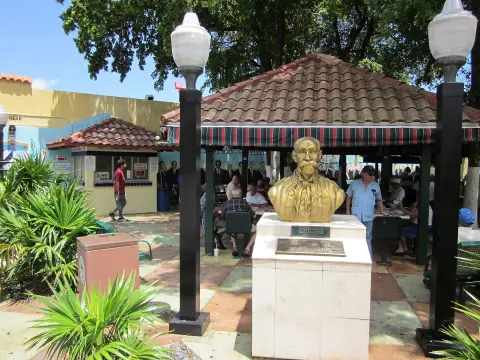
Right next door is Máximo Gómez Park, which everyone calls Domino Park. It is named after the Dominican-born general who led Cuban forces in the wars of independence against Spain. Since the early 1970s, older men, and some women, have gathered here under the pergola to play dominoes, talk politics and argue about baseball. Watch from the fence, smile, and do not interrupt a game. Photos are usually fine, but ask first.
Things you might not know
- By 1970, more than 85 per cent of Little Havana's residents were Cuban.
- Calle Ocho is part of the Tamiami Trail, the road that crosses the Everglades to Florida's Gulf coast.
- The National Trust for Historic Preservation named Little Havana a National Treasure in 2017.
Researched November 2026 from: en.wikipedia.org, miami.gov, en.wikipedia.org, miamiandbeaches.com. Fees and hours change, so check on the day.