🚗 Day trip · Everglades National Park, near Homestead, 75 km from central Miami
Anhinga Trail and Royal Palm, Everglades National Park
A short boardwalk where the Everglades come to you
🎧 Listen to this guide · about 5 min
Pop your earphones in and we'll walk you round.
Welcome to the southern gate of the Everglades. We will start at the Ernest F. Coe Visitor Center, then drive a few miles into the park to Royal Palm and the Anhinga Trail. This walk is short, less than a mile, but it can take you an hour or more, because every few steps something stops you. An alligator floating like a log. A turtle sunning on a branch. An anhinga, wings spread wide, drying its feathers. The trail runs over the clear water of Taylor Slough, and in the dry season the animals gather here in numbers that will astonish you. Walk slowly, speak softly, and let the Everglades show off.
The story of Anhinga Trail and Royal Palm, Everglades National Park
The Everglades were home to Native peoples for thousands of years. By the early twentieth century, settlers were draining the land, and plume hunters were killing wading birds by the thousand for feathers to decorate hats.
The Royal Palm area became one of the first protected places here. In 1916 the Florida Federation of Women's Clubs helped create Royal Palm State Park, named for the tall royal palms growing on a hardwood hammock called Paradise Key. It later became the core of the new national park and the site of its first visitor centre.
The man most often called the father of Everglades National Park is Ernest F. Coe, a landscape architect who moved to Miami in 1925 and campaigned tirelessly to protect the Everglades. Congress authorised the park in 1934, and President Harry Truman dedicated it on December 6, 1947. The park's main visitor centre near Homestead bears Coe's name. Today Everglades National Park is a UNESCO World Heritage Site, an International Biosphere Reserve and a wetland of international importance under the Ramsar Convention.
The setting
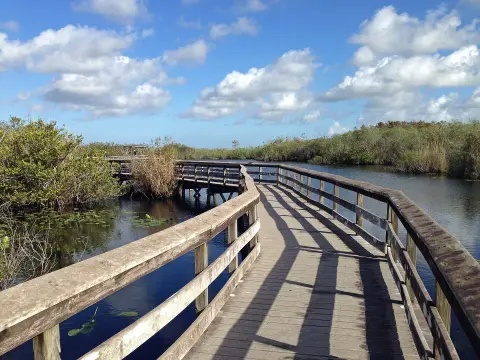
The Ernest F. Coe Visitor Center stands at the park's main entrance, west of Homestead and Florida City. A few miles beyond the entrance station lies Royal Palm, with a small visitor centre and two trails. The Anhinga Trail is a paved path and boardwalk, about 0.8 miles round trip, running over Taylor Slough, a shallow freshwater channel through sawgrass marsh. The nearby Gumbo Limbo Trail, about half a mile, winds through shady hardwood hammock under royal palms and strangler figs. The land is flat, the sky huge, and the water in the slough often clear enough to watch fish swimming.
Why it matters
The Anhinga Trail is one of the easiest places in the United States to see wildlife up close in a truly wild setting. It shows how the Everglades depend on water: in the dry season, animals crowd into deeper sloughs like this one to survive. Royal Palm is also where conservation in the Everglades began, thanks to the women's clubs of Florida. The Ernest F. Coe Visitor Center reminds us that one determined person can help save a landscape of over a million acres for everyone.
Your walk-through
The stops a guide would take you to, in order.
-
1
Ernest F. Coe Visitor Center
Start at the visitor centre at the main entrance. Look at the exhibits on Everglades wildlife and water, and watch the short film if it is showing. Ask the rangers what has been spotted at Royal Palm today, and whether any guided walks are planned. Then pay your entrance fee at the gate ahead and drive about four miles to the Royal Palm turn-off.
-
2
Royal Palm car park
At the Royal Palm car park, look at the cars. Some are covered with tarps. Black vultures here have a habit of pecking at rubber seals and wiper blades, so the park often lends tarps and bungee cords to protect your car. Use one. Look up at the royal palms that gave this place its name. They grow on Paradise Key, the hammock protected back in 1916.
-
3
Anhinga Trail, first stretch
Walk onto the Anhinga Trail. The first part follows a paved path beside open water. Look down. Fish, turtles and garfish often drift in the clear slough. Then look along the bank. Alligators often lie here in the sun, sometimes just a few feet from the path. Stay on the trail, keep your distance, and never feed them. They are wild animals, however calm they look.
-
4
The boardwalk over the marsh
Now step onto the boardwalk as it curves out over the sawgrass. Look for the anhinga, a dark bird with a long, snake-like neck, which swims underwater to spear fish, then perches with wings spread to dry. That is how the trail got its name. You may also see herons, egrets, cormorants and purple gallinules. Stop at the end and listen. The marsh is full of small sounds.
-
5
Gumbo Limbo Trail
Finish with the short Gumbo Limbo Trail, just next door. It feels like a different world, shady and green, under a canopy of hardwood trees. Look for the red, peeling bark of the gumbo limbo, the twisting roots of strangler figs, and ferns and air plants growing on branches. This hammock is a reminder that the Everglades are not only grass, but a mosaic of habitats.
Things you might not know
- The Anhinga Trail is about 0.8 miles round trip.
- Royal Palm State Park was created in 1916, long before the national park.
- Everglades National Park is a UNESCO World Heritage Site, a Biosphere Reserve and a Ramsar wetland.
Researched November 2026 from: nps.gov, nps.gov, nps.gov, en.wikipedia.org. Fees and hours change, so check on the day.