⭐ Must-see · Cerro Nutibara, Belén, 2 km from central Medellín
Pueblito Paisa on Cerro Nutibara
A little village on a hilltop, with the whole city below
🎧 Listen to this guide · about 6 min
Pop your earphones in and we'll walk you round.
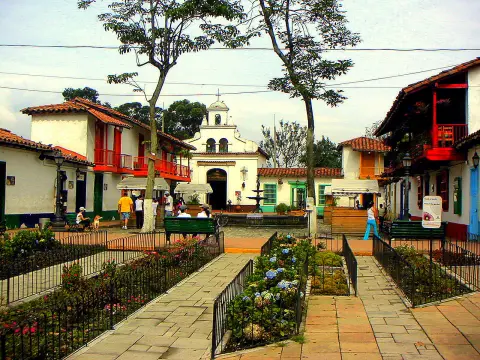
Right in the middle of Medellín, a green hill rises out of the city, and on its summit sits a tiny village. White walls, colourful wooden balconies, a small church, a plaza with a fountain. This is Pueblito Paisa, on top of Cerro Nutibara. It was built to show how a typical Antioquian town looked in the early twentieth century, the kind of place many Medellín families came from. Today you can stroll its little square, sip a coffee, and walk out to viewpoints where the whole Aburrá Valley spreads around you. Come in the late afternoon, and you may watch the lights of the city come on one by one across the mountains.
The story of Pueblito Paisa on Cerro Nutibara
Cerro Nutibara has had several names. It was once called Morro Marcela de la Parra, then Morro de los Cadavides. In 1929 the Sociedad de Mejoras Públicas, a civic society that has shaped many public spaces in Medellín, renamed it in honour of Nutibara, an Indigenous leader of the region at the time of the Spanish arrival.
In 1975, as Medellín marked three hundred years since its founding as a town, funding was approved to build a replica village on the summit. The architect Julián Sierra Mejía designed it, and he included real old pieces, such as doors, windows and an altar, brought from El Peñol and from Medellín. Pueblito Paisa opened on the 3rd of March 1978. The timing gave it extra meaning, because in those same years the old town of El Peñol was being demolished and relocated to make way for a hydroelectric reservoir.
The hill gained other attractions too. In 1983 a sculpture park was created on its slopes, presented as the first of its kind in Colombia, with works by Colombian and international artists. In 1984 the open-air Carlos Vieco Ortiz theatre opened on the northern side, named after a composer from Antioquia, and it became a well-loved stage for concerts, especially rock.
The setting
The hill rises about 80 metres above the surrounding city, with its summit at around 1,550 metres above sea level. A road and footpaths wind up through trees to the top. Pueblito Paisa is built around a small square, with a fountain in the middle and the little church at one end. Around it stand a barber shop, a school room, a town hall and small shops selling crafts and sweets, all with whitewashed walls, tiled roofs and brightly painted doors and balconies. From the edges of the summit, viewpoints look out in every direction: north towards downtown, south towards El Poblado and Envigado, and across to the mountains framing the valley.
Why it matters
Pueblito Paisa is a gentle introduction to Paisa culture, the regional identity of Antioquia. The word paisa comes from paisano, meaning fellow countryman. The village shows the values that many families here still hold dear: faith, hard work, mountain farming and a love of colourful homes. For locals, it is also a place of memory, reminding them of the small towns their grandparents left to come to the city. And for everyone, the hilltop gives one of the best free views of Medellín, helping you understand how the city fills its long, narrow valley.
Your walk-through
The stops a guide would take you to, in order.
-
1
The climb through the trees
We start at the foot of the hill and walk up through the trees. It is a steady climb of about fifteen to twenty minutes, so take your time. Notice how the noise of the traffic fades as you rise. Along the way you may see some of the sculptures from the park created in 1983. Look out for joggers and families. This hill is one of the city's favourite places for an early morning walk.
-
2
The village square and fountain
Welcome to Pueblito Paisa. Stand by the fountain and look around. Every Antioquian town is built around a square like this, with the church on one side and the most important buildings around it. Look at the painted balconies, the heavy wooden doors and the tiled roofs. Some of these doors and windows are genuine old pieces, rescued from the town of El Peñol and from old Medellín.
-
3
The little church
Now look at the small church at the end of the square. In real Antioquian villages, the church tower was always the tallest point, visible from the surrounding hills. The altar inside is said to have come from El Peñol, which was being moved in those years to make way for a reservoir. Step inside quietly if it is open, and imagine Sunday mornings in a mountain village a hundred years ago.
-
4
Shops and the old barber and school
Wander along the shopfronts. You will find a recreated barber shop, a school room and small stores selling crafts, hats, bags and sweets. Try an arepa or a cup of local coffee, or a sweet called obleas, thin wafers filled with arequipe, a milk caramel. Many of the sellers are local families, so a small purchase helps them. Take a seat on a bench and enjoy the slow village pace.
-
5
City viewpoints
Now walk out to the edge of the summit. Below you, the whole valley opens up. To the north you can see the tall buildings of downtown and the Metro line following the river. To the south, the towers of El Poblado and Envigado climb the slopes. All around, mountains close in the city. On a clear afternoon, stay until sunset and watch the lights spread up the hillsides as night comes.
Things you might not know
- The hill was renamed in 1929 in honour of the Indigenous leader Nutibara.
- Pueblito Paisa opened on 3 March 1978, designed by architect Julián Sierra Mejía.
- The sculpture park on the hillside, created in 1983, is described as the first of its kind in Colombia.
Researched November 2026 from: es.wikipedia.org, es.wikipedia.org. Fees and hours change, so check on the day.