⭐ Must-see · La Candelaria, city centre, 1 km from central Medellín
Plaza Botero and the Museo de Antioquia
Botero's generous bronzes in the beating heart of downtown
🎧 Listen to this guide · about 7 min
Pop your earphones in and we'll walk you round.
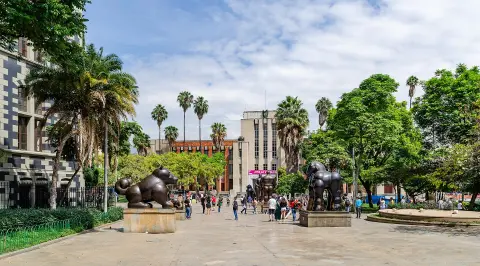
Welcome to the heart of downtown Medellín. Around you, street vendors call out, office workers hurry past, and children climb on the bronze toes of a giant horse. This is Plaza Botero. Twenty-three huge, round, smooth sculptures stand in the open air, all by Fernando Botero, the painter and sculptor born in this city. Next to them rises the Museo de Antioquia, where you can see his paintings and the collection he gave to his people. On the other side, the black and white Gothic towers of the Palacio de la Cultura add their own drama. Keep your bag close, enjoy the street life, and get ready to look at the human body in a whole new way.
The story of Plaza Botero and the Museo de Antioquia
Fernando Botero was born in Medellín in 1932. He became one of the best-known Latin American artists in the world, famous for figures with enormous, rounded volumes. He died in 2023, and his work is closely tied to his home city.
The Museo de Antioquia began in the nineteenth century as the Museo de Zea, and it is considered the first museum founded in Antioquia and the second in Colombia. Botero first offered to donate works to it in 1978. Around the year 2000 he made a major gift of his own paintings and sculptures, together with works by other international artists from his private collection. That same year the museum moved into the old Palacio Municipal, an Art Deco building designed by Martín Rodríguez and built between 1932 and 1937.
To make room for the sculptures, the city cleared the space in front of the museum, and Plaza Botero opened in 2002. It covers about 7,000 square metres and displays 23 monumental bronzes. Across the square stands the Palacio de la Cultura Rafael Uribe Uribe, designed by the Belgian architect Agustín Goovaerts in a neo-Gothic style. Work began around 1920 but was never fully completed to his plans, and the building was declared a national monument in 1982.
The setting
The plaza is a wide, open, paved space at the edge of the old centre, a short walk from Parque Berrío Metro station. The sculptures are spread out so you can walk around each one: a horse, a Roman soldier, a sleeping Venus, a cat, a dog, a hand, a head, a man walking, a woman with a mirror and more. On the north side rises the Museo de Antioquia, with its clean Art Deco lines. To the west, the Palacio de la Cultura shows off pointed arches, towers and a striking pattern of black and white stone. The elevated Metro line runs along one edge, and the streets around are full of shops, stalls and noise. It is lively, crowded and very real.
Why it matters
Plaza Botero is where Medellín's art is given freely to everyone. Anyone can walk in, touch the bronzes and sit in their shade, without a ticket. For many local families, this is their first encounter with world-famous sculpture. The square also helped bring life back to a city centre that many residents had avoided during harder years. Inside the museum, Botero's paintings sit next to works by other Colombian artists, including the murals of Pedro Nel Gómez, giving you a fuller picture of Antioquia's art. For visitors, it is the best single place to understand why Medellín is so proud of its most famous son.
Your walk-through
The stops a guide would take you to, in order.
-
1
Parque Berrío station
We start at Parque Berrío station, right in the old centre. Step down from the elevated Metro and walk towards the plaza. Listen to the sound of the streets: vendors selling fruit, lottery tickets and coffee from flasks. Downtown Medellín can feel intense at first. Keep your phone and bag close and follow the crowd. In two minutes you will see the first bronze figures appear between the buildings.
-
2
The Horse
Here is one of the most photographed sculptures in the square, a great bronze horse. Look at the way Botero swells the body, making it heavy, calm and solid. He said he was interested in volume, in giving form a sense of fullness and sensual presence. Notice how the bronze is polished bright where people touch it. Go ahead, you are allowed. These sculptures were made to be part of everyday life.
-
3
Sleeping Venus and the Roman Soldier
Now compare two figures. The Venus lies relaxed and dreamy, while the Roman Soldier stands in armour with a serious face. Botero often played with classical subjects from European art, giving them his own round, gentle style. There is humour here, but also affection. Walk around each one. From the side and from behind, the shapes change completely. This is sculpture designed to be seen from every angle.
-
4
Palacio de la Cultura Rafael Uribe Uribe
Turn to the west side and look at this extraordinary building. The black and white stonework, the pointed windows and the towers come from the design of Agustín Goovaerts, a Belgian architect who worked in Antioquia in the 1920s. It was meant to be the seat of the departmental government, but money ran out and his full plan was never finished. Today it houses cultural offices and exhibitions, and it is a national monument.
-
5
Museo de Antioquia, Botero rooms
Now we step inside the museum. On the upper floors you find the Botero rooms, with his paintings of families, priests, musicians, still lifes and scenes from Colombian life. Look for his paintings of Medellín itself. Then look for the works he donated by other artists from around the world. Before you leave, find the murals by Pedro Nel Gómez, another great artist from Antioquia, whose work tells the story of the region.
-
6
Museum terrace view
To finish, look out from the museum over the plaza below. From here you can see the sculptures as one family, scattered across the square, with people moving among them like small figures in a painting. This is exactly what the city wanted: art in the middle of ordinary life. Take a last photo, then walk back to the Metro, or wander a few blocks to explore more of downtown.
Things you might not know
- Plaza Botero holds 23 monumental bronze sculptures by Fernando Botero.
- The Museo de Antioquia occupies the Art Deco former Palacio Municipal, built 1932 to 1937.
- The Palacio de la Cultura was declared a Colombian national monument in 1982.
Researched November 2026 from: es.wikipedia.org, en.wikipedia.org, es.wikipedia.org, museodeantioquia.co. Fees and hours change, so check on the day.