💎 Hidden gem · El Poblado, 8 km from central Medellín
Museo El Castillo
A storybook castle on the slopes above El Poblado
🎧 Listen to this guide · about 6 min
Pop your earphones in and we'll walk you round.
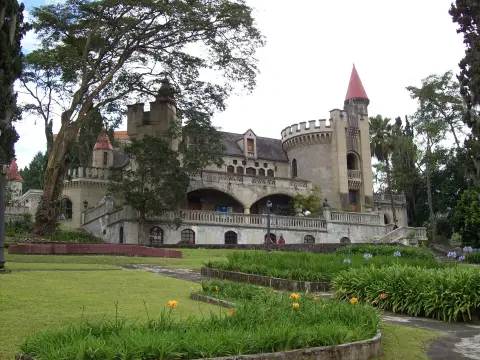
On the green slopes above El Poblado, behind a gate and a long drive, stands something you would never expect to find in Medellín: a castle. Pointed towers, stone walls, arched windows, and gardens laid out in the French style. This is Museo El Castillo. It was built as a private home in the 1930s, inspired by the castles of the Loire Valley in France, and today it is a museum of art and decorative objects. Walk through its rooms of porcelain, crystal, stained glass and tapestries, then step outside to stroll among fountains and flowers. It is calm, a little romantic, and one of the city's lesser-known treasures.
The story of Museo El Castillo
The castle was begun in 1930 by the architect Nel Rodríguez, with a design in a medieval Gothic style similar to the castles of the Loire. It was built for José Tobón Uribe, who brought the plans and used the house as a country home until his death in 1942. Construction ran until 1941.
After his death, the castle was bought by Diego Echavarría Misas, an industrialist from Itagüí, and his family, who made it their home. Echavarría was known in Antioquia for his support of education and culture. In 1971 he was kidnapped and murdered. After his death, his widow, known as Doña Dita, donated the castle with all its furnishings and decorations so that it could become a museum for the public.
Museo El Castillo opened as a museum in 1971. Since then it has shown its permanent collection in fourteen rooms, and added an art gallery for temporary exhibitions, a concert hall and an arts education centre. Concerts, classes and exhibitions have kept the house alive as a cultural centre rather than a silent monument. It remains one of Medellín's most distinctive cultural spaces, and a reminder of how private homes and family history became part of the city's public life.
The setting
The museum stands in El Poblado, in the south of the city, on a hillside surrounded by trees. You walk up a driveway to the castle, a stone building with towers, battlements and pointed Gothic windows. Inside, fourteen rooms display European and Asian porcelain, glassware, stained glass, Gobelin-style tapestries, paintings, sculpture and period furniture, arranged as a grand family home. Around the castle, the gardens are laid out in French style, with geometric lawns, flowerbeds, fountains and paths. From the grounds you catch glimpses of the city and the hills across the valley. A small concert hall and art gallery complete the site.
Why it matters
Museo El Castillo shows a side of Medellín's history that is often forgotten: the wealthy families of the early twentieth century, their dreams of Europe, and their role in the city's cultural life. It also carries the memory of a family loss turned into a gift to the public. Today, its concerts, classes and exhibitions make it a living cultural centre, not just a historic house. For you, it is a peaceful escape from the busy streets of El Poblado, and a chance to see fine decorative arts in an unexpected setting.
Your walk-through
The stops a guide would take you to, in order.
-
1
The driveway and castle façade
We begin on the driveway, looking up at the castle. Notice the towers, the battlements along the roofline and the pointed windows. This is Gothic revival style, built in the 1930s, borrowing from the castles of the Loire Valley in France. It is a dream of Europe, built in the mountains of Colombia. Take your photo here, with the towers framed by the trees.
-
2
Entrance hall and main salons
Step inside. The rooms are arranged as they might have been when the family lived here. Look at the furniture, the painted ceilings and the heavy curtains. Many pieces were collected abroad and shipped across the ocean. Imagine family gatherings and visitors arriving for dinner in these salons. Your guide will point out the most important objects and explain where they came from.
-
3
Porcelain and crystal rooms
In these rooms, you see collections of porcelain, crystal and glass from Europe and Asia. Look closely at the painted details on the plates and vases, and at the way the crystal catches the light. These were luxury objects, signs of wealth and taste in their time. Today they show the reach of trade and travel from early twentieth century Antioquia.
-
4
Stained glass and tapestries
Now look at the stained glass windows. When the sun shines through them, the colours spill across the floor. Nearby, large tapestries in the style of the famous Gobelin workshops of Paris hang on the walls. These woven pictures were once used to keep stone rooms warm, as well as to decorate them. Step back to see the whole scene, then come close to admire the stitching.
-
5
The French gardens
Finally, we step out into the gardens. They are laid out in French style, with neat lawns, clipped hedges, flowerbeds and fountains. Take a slow walk along the paths, or sit on a bench and enjoy the calm. Families come here for picnics and photos. Look back at the castle from the lawn. With the hills of Medellín behind it, it is a truly unusual view.
Things you might not know
- The castle was built between 1930 and 1941, inspired by the castles of the Loire Valley.
- It has been a public museum since 1971.
- The permanent collection is shown in fourteen rooms.
Researched November 2026 from: es.wikipedia.org, museoelcastillo.org. Fees and hours change, so check on the day.