⭐ Must-see · Sevilla, near Universidad station, 4 km from central Medellín
Medellín Botanical Garden
Orchids, birdsong and a forest of wooden flowers
🎧 Listen to this guide · about 6 min
Pop your earphones in and we'll walk you round.
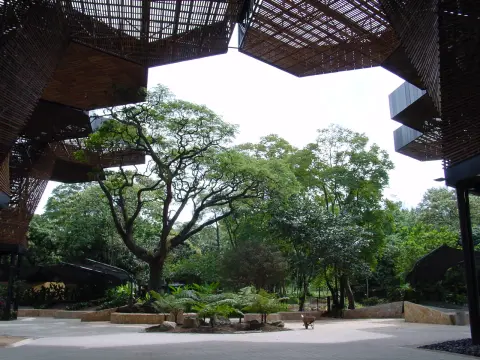
Step through the gate, and Medellín's traffic seems to melt away. Here, in the Joaquín Antonio Uribe Botanical Garden, tall trees shade winding paths, a lake reflects the sky, and iguanas sun themselves on the grass. Medellín calls itself the City of Eternal Spring, and this is the place to see why. Flowers bloom all year, and orchids, Colombia's national flower in the form of the Cattleya trianae, hang in colourful clusters. At the centre stands the Orquideorama, a huge structure of wooden hexagons that looks like a forest of giant flowers. Best of all, entry is free. Take a slow walk, find a bench, and listen to the birds.
The story of Medellín Botanical Garden
The garden is named after Joaquín Antonio Uribe, a naturalist and teacher from Antioquia who studied and wrote about the region's plants and animals. The land here, in the north of the city, had long been used as a park and leisure space by the people of Medellín.
On the 19th of April 1972 the botanical garden took its present name, when the site was enlarged and set up as a scientific garden. Its mission was to study, protect and show the plants of Antioquia and Colombia, one of the most biodiverse countries on Earth. For decades it has run research, plant collections and environmental education for schools, and many children in Medellín make their first nature walk here.
In the 2000s, the garden was renewed as part of a wider transformation of the northern part of the city, which also brought new science and cultural spaces nearby, such as the Parque Explora science museum. The most famous new addition was the Orquideorama, designed by Plan B Architects and JPRCR Architects. Its giant timber canopies were inspired by the shapes of flowers and trees, creating a covered space for orchid displays and events. The design was widely praised and is now one of the city's best-known modern structures.
The setting
The garden covers about 13 to 14 hectares of flat land near the Medellín River. Paths lead you through themed collections: palms, cacti and desert plants, tropical forest, a herbarium and a butterfly house. There is a lake with water plants and turtles, and plenty of open lawns. The Orquideorama sits near the main entrance, a grid of tall wooden hexagonal canopies, roughly twenty metres high, that branch out like trees and let filtered light and rain fall onto the orchids below. Restaurants and a café are found within the grounds. Just outside, Universidad Metro station, the Parque Explora science museum and the Planetarium are all within a few minutes' walk.
Why it matters
The botanical garden is one of Medellín's great public spaces. It is free, safe and open to everyone, from schoolchildren to retirees to visitors from abroad. It holds valuable plant collections and teaches people about Colombia's extraordinary biodiversity. Around 139 bird species have been recorded here, making it a favourite place for birdwatchers inside the city. The Orquideorama also shows Medellín's belief that good architecture belongs in public places, not just in private buildings. For you, it is a peaceful pause between museums and busy streets.
Your walk-through
The stops a guide would take you to, in order.
-
1
Main entrance
We enter from the side facing Universidad station. As you pass the gate, feel the temperature drop a little under the trees. Pick up a map if there is one, and notice the signs for the different collections. Listen for birds straight away. Parrots, tanagers and flycatchers are common here. Keep an eye on the grass too. The large iguanas you see are wild, and they are quite used to people.
-
2
The Orquideorama
Here is the Orquideorama. Stand underneath and look up. Each wooden canopy is made of hexagons that branch out, like a flower or the crown of a tree. The architects wanted the structure to feel like part of the garden, letting light, air and rain through. Below, you will find orchid displays and seasonal events. Colombia has one of the richest orchid floras in the world, and here you can see many of their shapes and colours.
-
3
The lake
Walk on to the lake. Look for water lilies, ducks and turtles sunning on the edges. This is a lovely place to sit for a moment. Early in the morning, herons and other water birds often fish along the banks. Across the water, the city buildings rise above the trees, a reminder that this green island lies right in the middle of a city of millions.
-
4
Butterfly house
Now step into the butterfly house. Move slowly, and the butterflies will drift past you, landing on flowers and sometimes on your shoulder. Inside, the plants are chosen to feed both caterpillars and adults. Look closely at the leaves and you may find eggs or chrysalises. Do not touch the butterflies, their wings are very delicate. Just watch, and enjoy the colours.
-
5
Desert garden and palms
We finish with two very different collections. In the desert garden, cacti and succulents show how plants survive in dry places, like the hot canyons of Colombia's interior. Nearby, tall palms show the other extreme, the wet tropical lowlands. Colombia has both, and many climates in between. When you leave, Parque Explora and the Planetarium are just next door if you want more.
Things you might not know
- The garden took its present name on 19 April 1972.
- Around 139 bird species have been recorded in the garden.
- The Orquideorama was designed by Plan B Architects and JPRCR Architects.
Researched November 2026 from: en.wikipedia.org, botanicomedellin.org, elcolombiano.com. Fees and hours change, so check on the day.