🚗 Day trip · Victoria (Rabat), Gozo, 40 km from central Malta (Valletta)
Ċittadella, Victoria
A hilltop fortress where Gozo once slept behind its walls
🎧 Listen to this guide · about 6 min
Pop your earphones in and we'll walk you round.
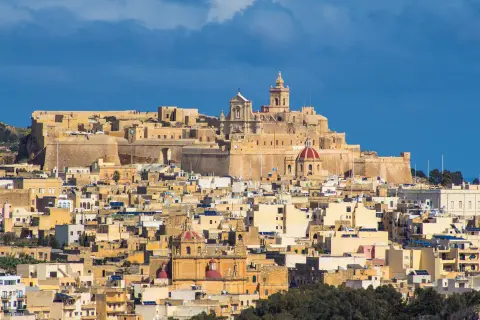
Welcome to Gozo, and to the Ċittadella, the stone crown sitting on top of its capital, Victoria. From the ferry you could see it on the horizon, and now you climb the ramp and pass through its walls. Inside, everything is quiet. Pale stone lanes, a grand cathedral, old houses turned into small museums, and ruins open to the sky. Walk up to the ramparts, and suddenly all of Gozo lies around you: little villages, each with its church dome, flat-topped hills, fields and the sea in every direction. For centuries, the people of this island sheltered here from pirates. Some nights, every family had to sleep inside. Take your time, follow the walls, and let the view tell you how small and precious this island is.
The story of Ċittadella, Victoria
This hill was probably settled in the Bronze Age, and in Punic and Roman times it was the acropolis, the upper citadel, of the town of Gaulos. Through the Middle Ages it remained Gozo's main refuge, defended by walls against raids from the sea.
The worst came in July 1551, when an Ottoman force besieged the citadel. It surrendered, and most of the people sheltering inside, many thousands of Gozitans, were carried off into slavery. The island was left almost empty. Afterwards, the Knights of St John strengthened the defences. Between 1599 and 1622 the southern walls were rebuilt for the age of gunpowder, while the northern walls kept their medieval form. For safety, Gozo's people were required to spend the night inside the walls, until that rule was lifted in 1637. After that the town below, then called Rabat, grew and the citadel slowly emptied.
The Cathedral of the Assumption was built between 1697 and 1711 to designs by Lorenzo Gafà. Its flat ceiling holds a famous painted illusion of a dome, by Antonio Manuele. From 2014 to 2016 a major restoration project repaired the walls and buildings and created a visitor centre in an old underground reservoir. The restored citadel reopened on 30 June 2016.
The setting
The Ċittadella stands on a steep, flat-topped hill in the centre of Gozo, above the town of Victoria, which locals still call Rabat. It is small, roughly a few hundred metres across, enclosed by walls on every side. Inside, the cathedral and the bishop's palace face a square at the top of a wide flight of steps. Around them are narrow streets, the Old Prison, small museums and the ruins of houses destroyed or abandoned centuries ago. The ramparts run all the way round, and you can walk along most of them. From the top you see almost the whole island.
Why it matters
The Ċittadella is the symbol of Gozo and its people. It tells the story of an island that suffered terribly from raids, survived, and slowly rebuilt. The cathedral is the seat of the Bishop of Gozo, and the great feasts of the island begin here. For visitors, it is the best place to understand Gozo's geography and history in one stop, and its restored walls are some of the finest in the Mediterranean.
Your walk-through
The stops a guide would take you to, in order.
-
1
The visitor centre
Start in the visitor centre, at the foot of the walls. It sits inside an old underground water reservoir, created in the nineteenth century and reused in the 2016 restoration. Watch the short film and look at the models of the citadel through history. It is a good way to understand what you are about to see. Then walk up the ramp and through the main gate.
-
2
Cathedral Square
At the top of the steps is the Cathedral of the Assumption, designed by Lorenzo Gafà and built between 1697 and 1711. Step inside and look up at the ceiling. What looks like a tall dome is a painting on a flat surface, made by Antonio Manuele. The real dome was never built. Walk toward the altar and watch the illusion shift as you move.
-
3
The Old Prison
Beside the square is the Old Prison, used from the sixteenth century until 1962. Step into the stone cells. On the walls you will see graffiti scratched by prisoners over the centuries: ships, crosses, hands, dates and names. Some are thought to date from the time of the Knights. Stand quietly for a moment. This was a hard place to be held.
-
4
The ruined quarter
Walk through the lanes to the northern side, where many houses lie in ruins. After the curfew ended in 1637, people moved down to the town and these homes were abandoned. Look at the old walls, cisterns and doorways. Some of the restored houses now hold small museums, including the Gozo Nature Museum and an old Gozitan house, part of the Heritage Malta combined ticket.
-
5
The ramparts
Climb to the ramparts and walk the circuit. Look north to the hill of Xagħra, where the Ġgantija temples stand. Look west toward the sea and the village of San Lawrenz. Count the church domes. Each village has its own. Notice the flat-topped hills, typical of Gozo. In 1551 the Ottoman army camped below these walls. Today, all you hear is the wind.
-
6
It-Tokk square
Walk back down to It-Tokk, the main square of Victoria, at the foot of the hill. Here the town comes alive, with cafes, a small market and the busy life of Gozo's capital. Look back up at the citadel walls from below. This is the best view of how the fortress sits on its hill. Rest here before heading on, or back to the ferry.
Things you might not know
- Until 1637, the people of Gozo were required to spend the night inside the citadel's walls for protection.
- The cathedral's dome is a painted illusion on a flat ceiling; the real dome was never built.
- The Old Prison was in use from the sixteenth century until 1962, and its cells are covered in prisoners' graffiti.
Researched November 2026 from: en.wikipedia.org, culturalheritagegozo.gov.mt, heritagemalta.mt, gozochannel.com. Fees and hours change, so check on the day.