🚗 Day trip · San Lorenzo de El Escorial, 55 km from central Madrid
Royal Monastery of San Lorenzo de El Escorial
Philip II's stone empire of faith, power and silence
🎧 Listen to this guide · about 6 min
Pop your earphones in and we'll walk you round.
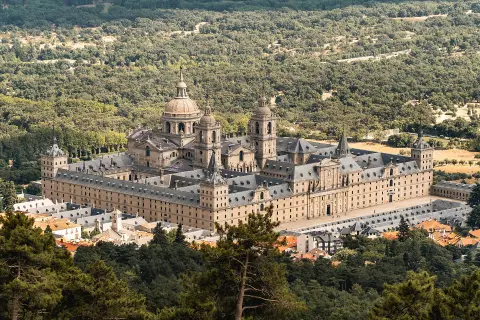
Welcome to El Escorial. Look at it: a great grey wall of granite, rising from the slopes of the Guadarrama mountains. This is not just a monastery. It is a royal palace, a church, a library, a school and a burial place for kings, all built as one. King Philip II made it the centre of his world, and he died here. It is severe, enormous and quietly powerful. Inside you will find painted ceilings, royal tombs of marble and gold, and the plain rooms where the most powerful man in Europe chose to live. Wrap up warm in winter. The mountain air is cool. Let's go in.
The story of Royal Monastery of San Lorenzo de El Escorial
On 10 August 1557, Spanish troops defeated the French at the Battle of Saint Quentin. That was the feast day of Saint Lawrence, San Lorenzo. King Philip II decided to build a great monastery in the saint's honour, and also a fitting tomb for his father, the Emperor Charles V.
He chose this site on the mountain slopes northwest of Madrid. The first stone was laid in 1563. The architect Juan Bautista de Toledo designed it, and after his death in 1567, his assistant Juan de Herrera took over and gave the building its sober, geometric style. The main construction was finished in 1584, a remarkably short time for a building of this size. A tradition says the grid-like plan recalls the gridiron on which Saint Lawrence was martyred.
Philip II governed his empire from here and died in his small bedroom beside the basilica in 1598. The Royal Pantheon beneath the altar was completed under Philip IV in 1654, and most Spanish kings since Charles V are buried there. The monastery is still home to a community of Augustinian friars. In 1984 UNESCO listed it as a World Heritage site.
The setting
El Escorial stands on a slope above the town of San Lorenzo de El Escorial, about an hour northwest of Madrid, with the Guadarrama mountains rising behind it. The building is a huge rectangle of grey granite, with towers at each corner and the great dome of the basilica rising in the middle. Long, plain façades are pierced by rows of small windows. Inside are courtyards, the basilica, the monastery, the royal apartments, the library and the pantheon. Around it lie terraced gardens with views over the plain toward Madrid.
Why it matters
El Escorial sums up Spain's golden age. It was the centre of a global empire, a symbol of Catholic faith during the Counter-Reformation, and a model for architecture across Spain and its colonies. Herrera's plain, powerful style spread widely and is still called Herrerian. The pantheon makes it the resting place of the Spanish monarchy. And its library, with priceless manuscripts, is one of the great historic libraries of Europe.
Your walk-through
The stops a guide would take you to, in order.
-
1
The Courtyard of the Kings
We enter through the main gate into the Courtyard of the Kings. In front of you is the façade of the basilica, with six statues of the kings of ancient Judah, including David and Solomon. Philip II saw himself as a builder of a temple, like Solomon. Look at the simple granite and the strict lines. This is the Herrerian style, beauty through order rather than decoration.
-
2
The Library
Now the Library. It is a long, vaulted hall with shelves of dark wood and a ceiling painted by Pellegrino Tibaldi with the liberal arts, from grammar to astronomy. Notice that the books are shelved with their spines facing inward, an old way to protect their gilded page edges. Philip II gathered manuscripts in Greek, Latin, Arabic and Hebrew. It is one of the great libraries of the Renaissance.
-
3
The Hall of Battles
This long gallery is covered in frescoes of Spanish victories. The most famous shows the medieval Battle of La Higueruela, painted in great detail, with thousands of soldiers and horses. Look closely at the armour, the banners and the camps. It is like a huge picture book of war, painted for the king to walk past every day.
-
4
Philip II's apartments
And now a surprise. The private rooms of Philip II are small and plain. Look at the bedroom. It has a window opening directly onto the high altar of the basilica, so the king could hear Mass from his bed in his final illness. He died here in 1598. Notice the chair where he rested his gout-ridden leg. The most powerful man in Europe chose to live like a monk.
-
5
The Royal Pantheon
We go down a marble staircase into the Royal Pantheon, beneath the altar. It is an octagonal chamber of dark marble and gilded bronze, completed in 1654. Around the walls, stacked in niches, are the tombs of Spanish kings and the queens who were mothers of kings, from Charles V onward. It is solemn, cool and very quiet. Please speak softly here.
-
6
The Basilica
We finish in the basilica. Look up at the great dome and the tall altarpiece of marble and gilded bronze, with paintings and sculpture. On either side are bronze figures of Charles V and Philip II with their families, kneeling in prayer toward the altar. The basilica is still a working church. If a service is on, take a seat and listen.
Things you might not know
- The monastery was dedicated to Saint Lawrence because the victory of Saint Quentin fell on his feast day, 10 August 1557.
- Books in the library are shelved with their spines facing inward to protect the gilded edges.
- Philip II's bedroom has a window opening directly onto the high altar of the basilica.
Researched November 2026 from: tickets.patrimonionacional.es, whc.unesco.org, en.wikipedia.org. Fees and hours change, so check on the day.