⭐ Must-see · Atocha, 1 km from central Madrid
Reina Sofía Museum
An old hospital that now holds Picasso's cry against war
🎧 Listen to this guide · about 6 min
Pop your earphones in and we'll walk you round.
Welcome to the Reina Sofía. If the Prado is Spain's past, this is its twentieth century, with all its hope and all its pain. The building began life as a hospital. Today its long white corridors lead to Picasso, Dalí, Miró and many artists you may not know yet. And at its heart hangs one painting that changed how the world sees war. Guernica. It is huge, it is black and white, and it is still shocking. We will walk through the old building, ride the glass lifts, find Guernica, and then step into the bold red-roofed extension. Keep your eyes open. Modern art rewards curiosity more than knowledge.
The story of Reina Sofía Museum
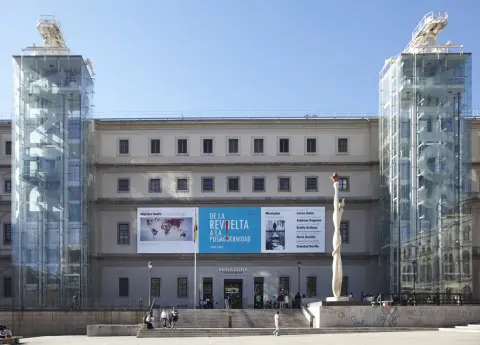
The main building was the General Hospital of Madrid. A hospital had existed in the city since the reign of Philip II, and in the eighteenth century, under Charles III, a vast new building rose here. The architects José de Hermosilla and then Francesco Sabatini shaped its sober granite and plaster wings around inner courtyards. It cared for the sick until 1965, when the hospital closed and the building faced demolition.
It was saved and listed as a historic monument in 1977. After restoration it opened as an art centre in 1986, and in 1988 it became a national museum named after Queen Sofía. In 1992 King Juan Carlos and Queen Sofía opened its permanent collection.
That same year Guernica arrived. Picasso had painted it in 1937 for the Spanish pavilion at the Paris International Exposition, after German and Italian planes bombed the Basque town of Guernica on 26 April that year. Picasso refused to let the painting go to Spain until democracy returned. It stayed in New York for decades, came to Madrid in 1981, and moved here eleven years later. In 2005 the French architect Jean Nouvel completed a new wing with a dramatic red roof.
The setting
The museum sits at the bottom of the Paseo del Prado, facing Atocha station. The old Sabatini building is long, heavy and plain, built of granite and brick around two courtyards. One courtyard is now a quiet garden with sculpture. On the outside, three glass-and-steel lift towers were added in the late 1980s. Riding them gives you a view over the rooftops of the Lavapiés neighbourhood. Behind, the Nouvel building wraps a triangular courtyard under a great overhanging roof clad in shining red metal. It holds temporary exhibitions, an auditorium and the library. Old and new are linked, and the contrast between them is part of the visit.
Why it matters
Guernica is more than a painting. It became a symbol of protest against the bombing of civilians, and against war in general. A woven copy once hung at the United Nations. The museum also tells the hard story of twentieth-century Spain, from the avant-garde to civil war, dictatorship and the return of democracy. It does not hide difficult themes. It is also a working hub for contemporary art, with talks, films and exhibitions. Coming here helps you understand the Spain you see on the streets today.
Your walk-through
The stops a guide would take you to, in order.
-
1
The Sabatini courtyard garden
We begin in the old hospital courtyard. Picture nurses and doctors hurrying along these arcades two hundred years ago. Now there is sculpture among the trees, and a hush that feels a world away from the traffic outside. Look up at the plain walls. This was built for use, not for show. Take a moment here. It is a good place to slow down before the intensity of the galleries upstairs.
-
2
The glass lift towers
Now we ride one of the glass lifts. They were added to the old façade in the late 1980s, and at the time many people hated them. Today they are part of the museum's face. As you rise, look out across the rooftops toward Lavapiés and Atocha. The ride itself is a small pleasure, and it shows you the spirit of the place: old walls, new ideas, side by side.
-
3
Early Spanish modernists
On the second floor the collection begins with the turn of the twentieth century. Look for the early Picassos and the Cubist work of Juan Gris, from Madrid, who worked in Paris beside Picasso. Notice how they break a guitar or a bottle into flat pieces and put it back together. They were asking a new question: what if a painting shows how we think about an object, not just how it looks?
-
4
Guernica
And here it is. Guernica, almost eight metres wide. Picasso painted it in a few weeks in 1937. There is no colour, only black, white and grey, like a newspaper photograph. Find the screaming mother holding her dead child. The horse with a spear through it. The bull, calm and watching. The broken soldier at the bottom, still gripping a snapped sword with a small flower beside it. Stand back. Let it fill your eyes. Photography is not allowed in this room.
-
5
Dalí and Miró
In the rooms nearby you meet two very different Catalans. Salvador Dalí, with his dreamlike, polished visions. Look for The Great Masturbator from 1929, a strange soft face melting into the ground. Then Joan Miró, with floating shapes and bright colour, like a child's alphabet invented by a poet. Both were part of the Surrealist movement in Paris, and both show how Spanish artists shaped modern art.
-
6
The Nouvel building
We finish by crossing into Jean Nouvel's extension. Stand under the red roof and look up at its underside. It reflects the people below like a giant, slightly blurred mirror. This wing hosts the temporary shows, so what you find inside changes. It is a bold bookend to the old hospital, and a reminder that this museum is about art still being made.
Things you might not know
- The main building was Madrid's General Hospital until 1965.
- Picasso would not allow Guernica into Spain until democracy returned; it arrived in 1981.
- Guernica is nearly eight metres wide and painted only in black, white and grey.
Researched November 2026 from: museoreinasofia.es, museoreinasofia.es, en.wikipedia.org, esmadrid.com. Fees and hours change, so check on the day.