⭐ Must-see · Baixa, 2 km from central Lisbon
Praça do Comércio
The grand front door of Lisbon, open to the river
🎧 Listen to this guide · about 5 min
Pop your earphones in and we'll walk you round.
Welcome to Praça do Comércio, the Square of Commerce. Lisboans often still call it Terreiro do Paço, the Palace Square, though the palace has been gone for more than two hundred and fifty years. Look around. Three sides are lined with yellow arcades, and the fourth opens straight onto the wide river, as if the city were stepping out to meet the sea. In the middle a king sits on horseback. Behind you a triumphal arch leads into the Baixa. This square has seen an earthquake, a royal murder and a revolution. Let's walk it slowly, from the water to the arch.
The story of Praça do Comércio
In the early 1500s King Manuel I left the old castle on the hill and built a new palace here on the riverbank, the Ribeira Palace. For two and a half centuries it was the centre of royal life, close to the docks where ships arrived from India and Brazil. Then, on the morning of 1 November 1755, a massive earthquake struck. A tsunami followed, then fire. The palace, its library and much of the lower city were destroyed.
The king's chief minister, the future Marquis of Pombal, led the rebuilding. His engineers and architects, including Eugénio dos Santos and Carlos Mardel, laid out the Baixa as a grid and designed this vast square. The new buildings housed government offices and trade. In 1775 the equestrian statue of King José I, by the sculptor Joaquim Machado de Castro, was unveiled. The great arch on the north side was only completed in 1875.
The square has stayed at the centre of Portugal's history. On 1 February 1908, King Carlos I and his heir, Luís Filipe, were shot dead in an open carriage at its corner. Two years later the monarchy fell. And on 25 April 1974, rebel troops took up position here during the Carnation Revolution, the peaceful coup that ended the dictatorship.
The setting
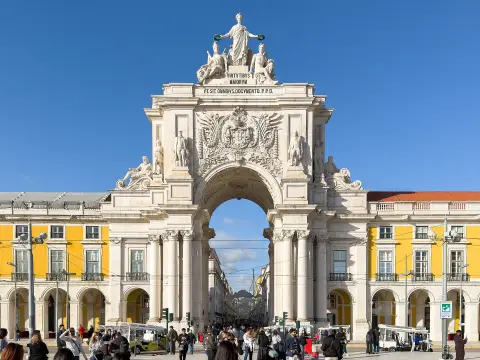
The square is a huge rectangle, roughly 170 metres a side, with the river on its southern edge. The arcaded buildings on three sides follow the Pombaline style: plain, regular and built with a flexible wooden frame inside the walls, designed to sway in an earthquake. In the centre stands the bronze statue of José I. On the river side, two marble columns and a flight of steps, the Cais das Colunas, lead down into the water. On the north side the Arco da Rua Augusta opens onto the pedestrian street that runs into the Baixa grid.
Why it matters
Praça do Comércio is the symbol of Lisbon's rebirth after 1755. The rebuilt Baixa around it was one of the first large urban plans in Europe designed with earthquake safety in mind. The square is still where the city celebrates, protests and gathers, from New Year concerts to football parties. For travellers it is the natural starting point: the river ferries, trams and the main shopping street all begin here.
Your walk-through
The stops a guide would take you to, in order.
-
1
Cais das Colunas
Start at the river, at the marble steps between two columns. For centuries this was the formal landing place for kings, ambassadors and important visitors arriving by boat. Sit on the steps and look at the water. Across the river is the south bank, with the Christ statue on the hill. Many locals say this is the best place in Lisbon to watch the light change at sunset.
-
2
Statue of King José I
Walk to the centre. King José I was on the throne during the earthquake. Here he rides in bronze, his horse trampling snakes, a symbol of the obstacles overcome. On the pedestal, look for a medallion with the portrait of the Marquis of Pombal, the minister who really ran the rebuilding. The statue is by Joaquim Machado de Castro and was unveiled in 1775.
-
3
Northwest corner
Now stroll to the corner where the square meets Rua do Arsenal. On 1 February 1908 the royal family was returning in an open carriage when gunmen opened fire. King Carlos I and his elder son, Luís Filipe, were killed. The younger son, Manuel, survived and became king, but the monarchy lasted only two more years. It is a quiet corner now, with nothing to mark the drama.
-
4
The arcades and Martinho da Arcada
Walk under the arcades on the east side. In the corner is Martinho da Arcada, a café that has been here since 1782. The poet Fernando Pessoa was a regular in his later years, and his favourite table is still remembered. Stop for a bica, the short Lisbon espresso, and perhaps a custard tart, standing at the counter like a local.
-
5
Arco da Rua Augusta
Finish at the great arch. Look up to see allegorical figures of Glory crowning Genius and Valour. Below them stand statues of national heroes, including Vasco da Gama and the Marquis of Pombal. A lift and a short stair take you up inside the arch to a small terrace with a view over the square and down Rua Augusta. Then walk through into the Baixa grid.
Things you might not know
- The buildings around the square use the Pombaline cage, a wooden frame inside the walls designed to flex during earthquakes.
- The café Martinho da Arcada has been open under the arcades since 1782.
- The arch on the north side was planned after the earthquake but only completed in 1875.
Researched November 2026 from: en.wikipedia.org, en.wikipedia.org, visitlisboa.com, en.wikipedia.org. Fees and hours change, so check on the day.