🚗 Day trip · Alchi village, lower Indus valley, 65 km from central Leh, Ladakh
Alchi Monastery
Ancient murals glowing in the dark beside the Indus
🎧 Listen to this guide · about 5 min
Pop your earphones in and we'll walk you round.
Welcome to Alchi. Unlike most Ladakhi monasteries, Alchi does not sit on a hilltop. It lies on flat ground beside the Indus, among apricot trees and village houses. From outside, its small mud buildings look humble. But step inside, let your eyes adjust to the darkness, and the walls come alive. Thousands of painted Buddhas. Goddesses in fine silks. Kings, musicians and animals, painted more than eight hundred years ago. This is one of the great treasures of Buddhist art in the Himalaya. Photography is not allowed inside, so you will have to look with your own eyes and remember. That is part of the magic.
The story of Alchi Monastery
Local tradition credits the founding of Alchi to the great translator Rinchen Zangpo, who lived from 958 to 1055 and is remembered for building temples across the western Himalaya. Scholars, however, read the inscriptions here differently. They suggest that the main buildings were built later, in the twelfth and early thirteenth centuries, by local noble patrons.
The Dukhang, or assembly hall, may date from around the middle of the twelfth century. The Sumtsek, a three-storey temple, dates from the early thirteenth century, and the Manjushri temple from around 1225. Their artists worked in a style that blended Tibetan traditions with the art of Kashmir, which was then a great centre of Buddhist painting and sculpture.
For reasons we do not fully know, active worship at Alchi faded in the fifteenth century. The temples came under the care of Likir Monastery, which still looks after them. Because they were left relatively untouched, many of their paintings survive in remarkable condition. Alchi stands on the old route between Leh and Kashmir, which helps to explain the Kashmiri influence in its art. Rinchen Zangpo is also credited with founding many other temples across Ladakh, Spiti and western Tibet, which is why so many places carry his name.
The setting
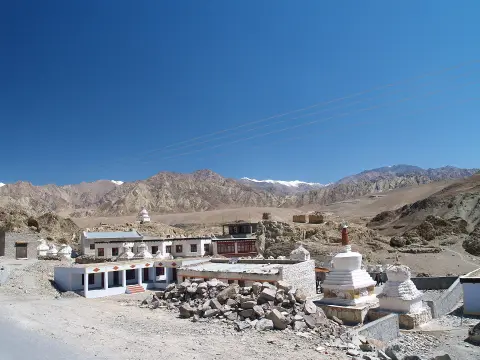
Alchi lies at about 3,100 metres, on the south bank of the Indus, about 65 km west of Leh. The complex, known as Chos-khor, is a cluster of small temples and chortens set among trees and fields. The main buildings are the Dukhang, the Sumtsek and the Manjushri temple. They are built of mud brick with carved wooden doorways and porches. Inside, the walls and ceilings are covered with paintings, and large clay statues stand in niches. Among the chortens is the Kakani chorten, considered unique to Alchi. Around the complex, the village has guesthouses, cafés and apricot orchards.
Why it matters
Alchi is one of the most important sites for understanding early Buddhist art in the Himalaya. Its murals preserve the style of Kashmir at a time when much of that art was lost elsewhere. Scholars from around the world study its paintings. For visitors, Alchi offers an intimate encounter with masterpieces that have survived for centuries, in a village setting that still feels peaceful and green.
Your walk-through
The stops a guide would take you to, in order.
-
1
The village path
We begin walking through Alchi village toward the temples. Notice the apricot trees, the willows and the water channels. The complex sits on flat ground near the river, which is unusual in Ladakh, where most monasteries crown hills. As you walk, look for stalls selling apricot jam and dried apricots, local specialities.
-
2
The chortens
Before we enter the temples, look at the chortens. Some have painted interiors, and you can look up inside to see mandalas on the ceilings. Among them is the Kakani chorten, considered unique to Alchi. Walk around them clockwise, as pilgrims do. They have stood here for centuries, guarding the path to the temples.
-
3
The Dukhang
Here is the Dukhang, the assembly hall. Step inside and let your eyes adjust. On the walls are a thousand Buddhas and great painted mandalas, circles of deities arranged in sacred patterns. Look at the fine detail, the bright colours, the graceful lines. Remember that no photography is allowed here. Take your time and look closely.
-
4
The Sumtsek
Now we visit the Sumtsek, the three-storey temple. Inside stand great clay figures of bodhisattvas, their lower robes painted with tiny scenes of palaces, shrines and people. Look closely at the robes of the figures. They are like miniature worlds, full of life. This is one of the most extraordinary rooms in the Himalaya.
-
5
The Manjushri temple
Next is the Manjushri temple, from around 1225. Inside, four images of Manjushri, the bodhisattva of wisdom, sit back to back on a shared platform, facing the four directions. Look at the paintings on the walls around them. Manjushri carries a sword to cut through ignorance. It is a fitting image to end our visit.
-
6
The riverside
Finally, walk to the edge of the village and look down at the Indus. The river here flows west toward Kargil and on to Pakistan. This valley was a route for traders, pilgrims and artists for centuries. Perhaps the painters of Alchi came this way from Kashmir, carrying their skills along the river.
Things you might not know
- Local tradition credits Alchi to the translator Rinchen Zangpo, but inscriptions suggest the main temples date from the twelfth and thirteenth centuries.
- Its paintings show a rare blend of Tibetan and Kashmiri Buddhist art.
- Photography is not permitted inside the temples, to protect the ancient paintings.
Researched November 2026 from: en.wikipedia.org, tourism.ladakh.gov.in, archresearch.tugraz.at. Fees and hours change, so check on the day.