🚗 Day trip · Alor Setar, Kedah, 75 km from central Langkawi
Zahir Mosque, Alor Setar
Black domes and white arches in Kedah's royal heart
🎧 Listen to this guide · about 6 min
Pop your earphones in and we'll walk you round.
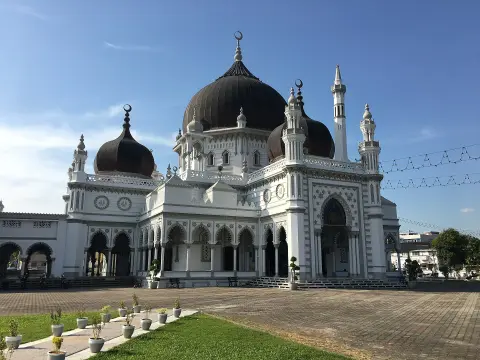
Welcome to Alor Setar, the royal capital of Kedah, the state to which Langkawi belongs. After a ferry ride across the strait and a short drive inland, we arrive at one of the finest mosques in Malaysia, Masjid Zahir. Look up. Five black domes rise above white walls and arches, with slim minarets reaching toward the sky. The courtyard is calm and the air feels still. Here, the call to prayer echoes over a city with deep roots. Take off your shoes, slow your steps and look closely at the details. This is a place of worship first, so we visit with respect. But visitors are welcome to admire it outside prayer times.
The story of Zahir Mosque, Alor Setar
The mosque was built in the early twentieth century, when Kedah was a Malay sultanate under British influence. Construction began in 1912, and the mosque was formally opened on 15 October 1915 by Sultan Abdul Hamid Halim Shah of Kedah.
It stands on ground with a special meaning. The site is said to have been a burial ground for Kedah warriors who died fighting the Siamese invasion of 1821, the same war that, in Langkawi legend, saw the burning of the rice fields at Padang Matsirat. The mosque's design is often said to have been inspired by the Azizi Mosque in Langkat, in northern Sumatra.
Over the century since, Masjid Zahir has become the state mosque of Kedah and one of the best known mosques in Malaysia. It has been cared for and restored, but its original form remains. Each year, the state's Quran recitation competition is held here, drawing reciters and listeners from across Kedah. It remains a living place of worship at the heart of the city. Alor Setar itself grew up around the royal court of Kedah, and many of its oldest buildings stand within a short walk of the mosque. Together they give a sense of how the sultanate looked a century ago, when the mosque was new and the city far smaller than it is today.
The setting
Masjid Zahir sits in the centre of Alor Setar, close to the royal and civic buildings of old Kedah. The mosque is built in a style that blends Islamic and Indo-Saracenic, or Moorish, influences. It is crowned by five black domes, a large central one and four smaller ones, rising above white walls. Slender minarets stand at its corners. Around the prayer hall, arched verandas give shade and let breezes pass through. The courtyard is open and calm, with paths and gardens. Inside, the prayer hall is airy and bright, with columns and simple decoration. The white walls and dark domes make a striking contrast against the sky.
Why it matters
Masjid Zahir is a symbol of Kedah's identity, faith and history. As the state mosque, it is a focus for prayer, festivals and the annual Quran recitation competition. Its site, linked to the warriors of 1821, ties it to the struggles that shaped the state. For visitors from Langkawi, it offers a window into the mainland heart of Kedah, a reminder that the island is part of a larger story of sultans, trade and faith. It is also simply beautiful, and worth the journey for its architecture alone.
Your walk-through
The stops a guide would take you to, in order.
-
1
The ferry to Kuala Kedah
We start in Kuah, Langkawi, boarding the ferry to Kuala Kedah on the mainland. The trip takes around one hour and forty-five minutes. Watch Langkawi's islands fade behind you as the coast of Kedah appears, low and green. From Kuala Kedah, a short drive of around 20 minutes brings us inland to Alor Setar, past rice fields and small towns.
-
2
The front of the mosque
Here we are. Stand back and take in the whole building. Count the domes. There are five, black and gleaming, rising above white walls. Many people say they represent the five pillars of Islam. Look at the minarets, tall and slim, from which the call to prayer once rang out by voice alone. It is an elegant, balanced design, simple and grand at once.
-
3
The arches and verandas
Walk closer and look at the arches along the verandas. They are tall and rounded, shading the walls from the sun and letting the breeze flow through. This is a style seen in many mosques and palaces of the period, mixing Islamic and Indian influences, often called Indo-Saracenic. Run your eyes along the repeating arches. They create a gentle rhythm, calm and orderly.
-
4
The courtyard
Step into the courtyard, after removing your shoes where shown. Notice the stillness. Remember the story of this site. It is said to have been a burial ground for Kedah warriors who fell during the Siamese invasion of 1821. Today, it is a place of prayer and peace. Stand quietly for a moment, and let the history of the place settle around you.
-
5
The prayer hall
If you are allowed inside, look into the prayer hall. Visitors usually view it from the edge, outside prayer times. Notice the open, airy space, the columns and the light pouring in through the windows. Look for the mihrab, the niche that shows the direction of Mecca. Speak softly, and follow any guidance from mosque staff. Many are happy to answer questions.
-
6
A view from across the square
Before you leave, walk a short way across the road for a last look back. From a distance, the domes stand out against the sky, especially in the late afternoon light. Nearby are other historic buildings of old Alor Setar, worth a stroll if you have time. Then we head back to Kuala Kedah for the ferry home to Langkawi.
Things you might not know
- The mosque was formally opened on 15 October 1915.
- It is crowned by five black domes.
- Kedah's annual Quran recitation competition is held at the mosque.
Researched November 2026 from: en.wikipedia.org, nas.gov.sg, api.nst.com.my, malaysia.travel. Fees and hours change, so check on the day.