💎 Hidden gem · Jerusalem Hills, west of the city, 12 km from central Jerusalem
Sataf
Spring water, stone terraces and pine-scented trails
🎧 Listen to this guide · about 6 min
Pop your earphones in and we'll walk you round.
Just twenty minutes from the city, the road bends and the hills open out. Below you, stone terraces step down the slope like a giant staircase, planted with olives, almonds, figs and vines. Somewhere among them, two springs flow out of the rock. This is Sataf, a favourite escape for Jerusalemites who want fresh air and a gentle hike. You will smell pine and wild herbs, hear birds in the trees, and see families picnicking by the pools. The trails here are short and well marked, but they are steep in places, so bring water and good shoes. Take your time. Sataf is a place to slow down and watch the light move across the valley.
The story of Sataf
People were farming here long before Jerusalem became a great city. Archaeologists have found the remains of a Chalcolithic village, from around 4,000 BCE, and traces of farming that are among the oldest in the region. Over thousands of years, farmers built terraces on these steep slopes to hold back soil and water, and dug tunnels into the hillside to collect water from the springs.
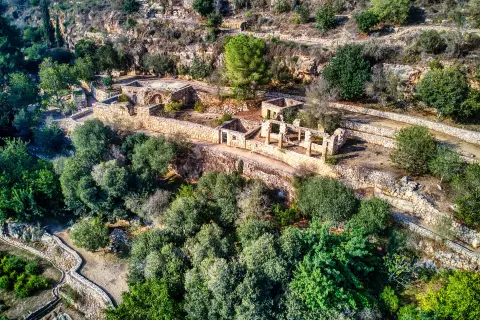
In more recent centuries, Sataf was a small Palestinian Arab village, documented from the Ottoman period. Its population was recorded as about 540 people in 1945. In July 1948, during the war, its residents were displaced, and the land became part of Israel. Ruins of village houses still stand on the hillside.
From the early 1980s, the Jewish National Fund, known as KKL-JNF, began restoring the old terraces and the stone pools at the two springs. It planted forest around the site and created walking trails. Today Sataf is run as a site showing traditional hill-country farming, with small plots that local families rent and cultivate, and it has become one of the best known nature spots close to Jerusalem.
The setting
Sataf lies on the steep slopes above the Sorek Valley, called Wadi as-Sarar in Arabic, in the Jerusalem Hills. From the upper car park, the land falls away towards the valley floor, covered in terraces, pines and orchards. Two springs, Ein Sataf and Ein Bikura, emerge from the hillside, each feeding a stone pool and a system of channels that waters the terraces. At Ein Bikura, a narrow tunnel leads back into the rock to the spring's source. Marked trails in different colours link the springs, the old village ruins and lookouts, so you can make a short loop or a longer circuit.
Why it matters
Sataf shows how people have farmed these dry hills for thousands of years, using terraces and springs with remarkable skill. It is also a much-loved green space for city families, especially in spring when the hills are covered in wildflowers. The ruins of the village are a reminder of the area's more recent history. For visitors with a car, it offers an easy taste of the Jerusalem countryside, close enough for a morning walk before lunch.
Your walk-through
The stops a guide would take you to, in order.
-
1
Upper car park and lookout
Start at the upper car park and walk to the lookout. Below you is the Sorek Valley, with the railway line and the road winding along its floor. Across the valley, forested hills roll away towards the coastal plain. Look at the terraces below your feet. Every one of those stone walls was built by hand, some of them centuries ago, to turn a steep rocky slope into farmland.
-
2
Ein Bikura
Follow the marked trail down to Ein Bikura, the first spring. Its water flows out of a narrow tunnel cut into the rock. If you have a torch and do not mind getting your feet wet, you can step a little way into the tunnel. Outside, the water collects in a stone pool, then flows along channels to the terraces below. On hot days, children splash in the shallows. Please keep the water clean.
-
3
The terraced plots
Walk along the terraces below the spring. Many of these small plots are tended by local families who rent them from the site and grow vegetables, herbs and fruit trees in the traditional way. You will see figs, olives, grapevines and almond trees. In late winter the almonds blossom white and pink. Stay on the paths, and do not pick the fruit, as it belongs to the people who grow it.
-
4
Ein Sataf
Continue along the trail to Ein Sataf, the second spring, with its own pool shaded by trees. Nearby you will see the ruins of the old village houses, with their thick stone walls and arched rooms, now open to the sky. Stop here for a picnic. Take a moment to imagine the families who lived and farmed here, and the many generations before them who drew water from this same spring.
-
5
The trail back up
From Ein Sataf, take the trail back up to the car park. It is a steady climb, so go slowly and take breaks in the shade of the pines. Look back now and then at the terraces below and the valley beyond. On a clear day the views are wide and calm. If you have more time and energy, longer marked trails continue along the hillside towards the Sorek Valley.
Things you might not know
- Remains of a Chalcolithic village from around 4,000 BCE have been found at Sataf.
- The site has two springs, Ein Sataf and Ein Bikura, both feeding restored stone pools.
- KKL-JNF began restoring Sataf's ancient terraces in the early 1980s.
Researched November 2026 from: en.wikipedia.org, kkl-jnf.org, israel-in-photos.com. Fees and hours change, so check on the day.