⭐ Must-see · Beyazıt, 1 km from central Istanbul
Grand Bazaar
Sixty streets of lamps, carpets and gold under stone vaults
🎧 Listen to this guide · about 6 min
Pop your earphones in and we'll walk you round.
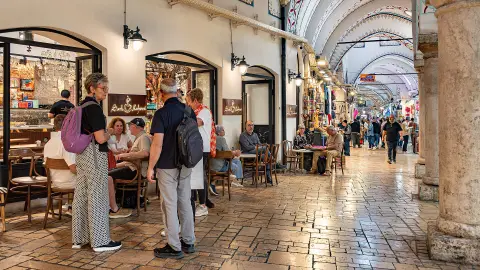
Welcome to the Kapalıçarşı, the Covered Market, known to the world as the Grand Bazaar. Step through the gate and the city's noise softens into something older. Painted vaults arch overhead. Lamps glow in shop windows. Carpets, copper, leather, gold and glass compete for your eye, and every few steps someone invites you for tea. This bazaar has been trading for well over five centuries. It is a town under one roof, with its own streets, mosques, fountains and cafés. Do not worry about getting lost. Getting lost is the point. Keep an eye on the gate names, take your time, and remember that bargaining here is a friendly conversation, not a fight.
The story of Grand Bazaar
The story begins just after the Ottoman conquest. In the winter of 1455 to 1456, Sultan Mehmed II ordered a strong stone hall built for valuable goods: textiles, jewels and arms. This was the Cevahir Bedesten, the Jewel Bedesten. Its rents paid for the upkeep of Hagia Sophia, by then the city's great mosque. A second covered hall, the Sandal Bedesten, followed. Sources differ on whether it dates from Mehmed's time or from Suleiman's reign in the sixteenth century.
Around these two strong halls, shops, lanes and inns, called hans, grew and were roofed over until they joined into one vast covered market. Guilds controlled each trade, and each street had its craft: jewellers, cap makers, slipper makers, sword makers.
The bazaar has suffered fire and earthquake many times. An earthquake in 1766 caused damage, and the great earthquake of 1894 led to years of repairs that made the complex smaller. Fires struck again in 1943 and 1954, and the last restoration was finished in 1959. Through all of it the bazaar kept trading. Today, on a busy day, hundreds of thousands of people pass through its gates, many of them locals buying gold for weddings and family occasions.
The setting
The bazaar sits on a hill in the old city, between the Beyazıt Mosque and the Nuruosmaniye Mosque. It covers about thirty thousand square metres, with around sixty covered streets and, by most counts, about four thousand shops. The lanes run in a rough grid, with the main street, Kalpakçılar, lined with jewellers. At the heart sits the old Cevahir Bedesten, a domed stone hall with thick walls and iron doors. Around the edges, old hans with their own courtyards house workshops where silver is cast and gold is polished. Gates open onto every side, each with its own name, so it pays to note which one you came in by.
Why it matters
The Grand Bazaar is not a museum. It is a working market, and the local trade in gold and jewellery here is still serious business. It shows how an Ottoman city was built around trade and charity, with market rents funding mosques and schools. Its layout, its hans and its crafts link today's shopkeepers with guilds that worked here for centuries. For visitors, it is a lesson in patience, hospitality and the very old art of the deal. Come once with a list and once without one. Both kinds of visit teach you something.
Your walk-through
The stops a guide would take you to, in order.
-
1
Nuruosmaniye Gate
Enter from the Nuruosmaniye Gate, beside the graceful baroque mosque of the same name. Look above the arch for the Ottoman crest. Once inside, the lane straight ahead is Kalpakçılar, the main street of the bazaar. The name comes from the makers of fur caps who once worked here. Today it shines with gold. Stroll slowly, and notice how each window is arranged like a small stage.
-
2
The Cevahir Bedesten
Turn into the Cevahir Bedesten, the oldest part of the bazaar. This domed stone hall was built for Mehmed the Conqueror in the 1450s. Its walls are thick and its doors were locked at night, because this is where the most precious goods were kept. Today you will find antiques, old silver, coins, icons and Ottoman curios. Look up at the domes and imagine the hall lit by oil lamps.
-
3
The Sandal Bedesten
Next, find the Sandal Bedesten, a second great hall with twenty small domes on stone piers. Its name may come from sandal, a fabric of silk and cotton that was traded here. It is brighter and calmer than the lanes outside. In the twentieth century it was used for auctions of carpets and antiques. Pause here, away from the crowds, and listen to the hum of the market around you.
-
4
Zincirli Han
Head to the north side and look for Zincirli Han, the Han with the Chain. A han was an inn and warehouse for merchants, with rooms around a courtyard. Here you step out into daylight, into a small, pretty square of stone arcades. Today it holds jewellers and workshops. If a door is open, you might see craftsmen at work. It is a quiet corner that many visitors miss.
-
5
The carpet and textile lanes
Wander back through the lanes of carpets and kilims. Every rug has a story of a region and a weaving tradition. If you are interested, sit down, take the tea and ask questions. Shopkeepers love to talk about knots, dyes and villages. There is no obligation to buy. If you do buy, take your time, compare and agree a price you are happy with.
-
6
Beyazıt Gate and the Book Bazaar
Leave by the Beyazıt side and step through to the Sahaflar Çarşısı, the old Book Bazaar, in a shady courtyard by the Beyazıt Mosque. Booksellers have gathered near here since Ottoman times. Browse prints, maps and books in many languages. Then cross into Beyazıt Square, the site of a great Roman forum, with Istanbul University's grand gate before you.
Things you might not know
- The oldest part, the Cevahir Bedesten, was built in the winter of 1455 to 1456 for Mehmed the Conqueror.
- Rents from the first bazaar buildings helped pay for the upkeep of Hagia Sophia after it became a mosque.
- The bazaar is generally estimated to have around sixty covered streets and some four thousand shops, though there is no official count.
Researched November 2026 from: en.wikipedia.org, timeout.com, istanbul.com. Fees and hours change, so check on the day.