💎 Hidden gem · Dean, West End, 2 km from central Edinburgh
Dean Village
A quiet mill village tucked into a green river gorge
🎧 Listen to this guide · about 6 min
Pop your earphones in and we'll walk you round.
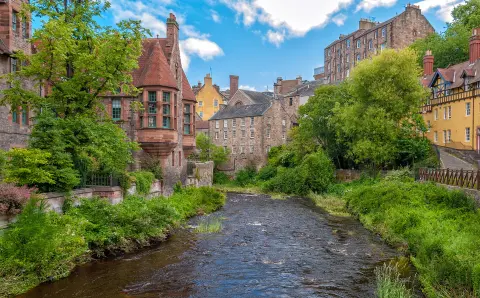
Walk just ten minutes from the West End, turn down a steep lane, and the city simply disappears. Welcome to Dean Village. Here the Water of Leith rushes over stones in a deep, wooded valley, and old stone mill buildings crowd the banks. Red roofs, little bridges and gabled houses make it look like somewhere in the countryside. For more than 800 years this was a place of work, with mills grinding grain for the city. Now it is a peaceful corner of homes and gardens, linked to a riverside path you can follow for miles. Please remember that people live here, so speak softly and enjoy it the way the locals do, slowly.
The story of Dean Village
The name Dean comes from dene, an old word for a deep valley. The first known mention appears in the founding charter of Holyrood Abbey, around 1145, when King David I granted one of his mills here to the abbey. For centuries the place was called the Water of Leith Village, and for more than 800 years it was a busy grain milling centre, with as many as eleven mills working at once, all driven by the river.
The village was closely tied to the Incorporation of Baxters, Edinburgh's guild of bakers. In 1675 they built a large granary here, and you can still see carved stones on the buildings showing loaves, pies and crossed baker's peels. Milling declined in the nineteenth century as bigger mills took over, and the village grew poor.
In 1831 and 1832 a new bridge, designed by the engineer Thomas Telford, was built high above the valley, opening in 1833. Traffic now passed overhead and the village was left behind. In the 1880s the newspaper owner John Ritchie Findlay paid for Well Court, a red sandstone courtyard of homes for workers, partly to improve the view from his own house above. In the later twentieth century the old buildings were restored as homes, and in 1983 the Water of Leith Walkway was created through the valley.
The setting
Dean Village lies in a steep-sided gorge cut by the Water of Leith, below the elegant streets of the West End and the New Town. The river runs over small weirs and under an old stone bridge, once the main road out of the city to the north-west. Around it cluster former mills and granaries, many now flats, with Well Court and its clock tower standing out in warm red stone. High above to the east the four arches of the Dean Bridge carry traffic about 32 metres over the water. Paths lead along both banks under trees, west toward the Scottish National Gallery of Modern Art and east toward Stockbridge.
Why it matters
Dean Village is one of the best places in Edinburgh to see how the city once worked. Its mills fed the capital for centuries, and the baker's carvings are a reminder of the trades that ran city life. Today it is part of a conservation area and a green corridor along the river, valued by locals for quiet walks and wildlife. It shows how industrial places can be reborn as homes without losing their character.
Your walk-through
The stops a guide would take you to, in order.
-
1
Bell's Brae
Start at the top of Bell's Brae, the steep cobbled lane that drops from Queensferry Street. This was the main road out of Edinburgh to the north-west before the Dean Bridge was built. As you walk down, the noise of traffic fades and you start to hear the river. Look for the old granary building on your right, and carved stones above doorways showing loaves and pies, symbols of the bakers' guild.
-
2
Old bridge over the Water of Leith
At the bottom you reach the old stone bridge across the Water of Leith. Stand in the middle and look both ways. Upstream the river tumbles over a weir past old mill buildings. Downstream it curves under trees toward Stockbridge. For centuries water like this turned mill wheels day and night, grinding grain into flour for Edinburgh's bakers. Today you may spot a heron or even a kingfisher if you are lucky.
-
3
Well Court
Cross the bridge and turn to Well Court, the red sandstone courtyard with the clock tower. It was built in the 1880s for working families, paid for by John Ritchie Findlay, owner of The Scotsman newspaper. So the story goes, he also wanted a nicer view from his grand house up above. It was designed with a community hall at its centre. Today it is still homes, so please admire it quietly from the courtyard.
-
4
Riverside path to Dean Bridge
Follow the Water of Leith Walkway downstream along the riverbank. Soon the Dean Bridge soars above you, four tall arches carrying the road about 32 metres overhead. Thomas Telford designed it, and it opened in 1833. Stop underneath and look up. The scale is astonishing from down here. The bridge opened up the land to the north for new houses and turned the village into a backwater.
-
5
St Bernard's Well
Carry on a few minutes more to St Bernard's Well, a little round temple by the river. It was built in 1789 over a mineral spring, designed by the painter Alexander Nasmyth. Inside stands a statue of Hygieia, the Greek goddess of health. People once came to drink the water, which they believed did them good. It smelt strongly of sulphur. From here you can continue to Stockbridge for coffee.
Things you might not know
- At its peak the valley had up to eleven working mills, all powered by the Water of Leith.
- The Dean Bridge, by Thomas Telford, opened in 1833 and stands about 32 metres above the river.
- St Bernard's Well holds a statue of Hygieia, the Greek goddess of health.
Researched November 2026 from: en.wikipedia.org, waterofleith.org.uk, en.wikipedia.org. Fees and hours change, so check on the day.