💎 Hidden gem · Trsteno, 18 km from central Dubrovnik
Trsteno Arboretum
A Renaissance garden of shade, stone and sea
🎧 Listen to this guide · about 5 min
Pop your earphones in and we'll walk you round.
Welcome to Trsteno. Just a short drive up the coast from Dubrovnik, this village hides a garden that has been growing for more than five hundred years. Before you go in, look at the two giant plane trees in the village square. They are older than most buildings in Dubrovnik. Inside the gate is the summer estate of a noble family, with a villa, a chapel, shaded walks, a stone fountain and terraces dropping toward the sea. It is green, cool and quiet, with the sound of water and cicadas. Walk slowly here. This place was made for long conversations under the trees.
The story of Trsteno Arboretum
Trsteno was the summer estate of the Gučetić family, also known as Gozze, one of the noble houses of the Republic of Dubrovnik. The garden was laid out in the late fifteenth century. It already existed by 1492, when the family built a small aqueduct to bring water to the estate, and that aqueduct is still in use today.
Over the centuries the family shaped a classic Renaissance garden with geometric beds, a villa and terraces, and later added a Baroque fountain and grotto with a statue of Neptune. Ships of the Republic brought back seeds and plants from distant voyages, and many grew here.
In 1948 the estate was given to the Croatian Academy of Sciences and Arts, which has cared for it ever since. The garden has suffered hard blows. On 2 and 3 October 1991, during the war, it was attacked by Yugoslav gunboats and aircraft and set on fire. In 2000 a forest fire during a drought burned around 120,000 square metres. Both times the gardeners replanted. More recently, the arboretum appeared in Game of Thrones as the gardens of the Red Keep.
The setting
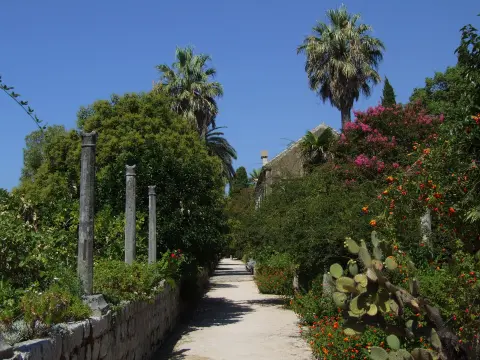
The arboretum covers about 25 hectares on a slope between the coastal road and the sea. Near the entrance is the Renaissance part, with the villa, a small chapel and formal beds framed by low hedges. Paths lead down through shaded avenues of palms, cypresses, oaks and exotic trees to a stone balcony over the water. The Baroque Neptune fountain sits at the end of the aqueduct, with nymphs and a pool. Beyond lie wilder areas of pine and native woodland. In the village square stand two huge oriental plane trees, more than 500 years old.
Why it matters
Trsteno is one of the oldest arboretums in this part of Europe and a rare surviving Renaissance garden on the Adriatic. It shows how Dubrovnik's nobles lived in summer, between learning, leisure and farming. It is also a living collection for science, cared for by the Academy. And it is a story of recovery, a garden burned twice and replanted each time.
Your walk-through
The stops a guide would take you to, in order.
-
1
Plane trees in the village square
Before entering, stand beneath the two oriental plane trees in the village square. Look up into their branches and around their great trunks. They are more than five hundred years old, among the oldest trees on this coast. They were growing here while the Gučetić family planned their garden. Locals have gathered in their shade for generations.
-
2
The villa and chapel
Inside the gate, you reach the summer villa of the Gučetić family and a small chapel. This was a working estate as well as a retreat. Picture nobles arriving from the city in the hot months, reading and talking on the terraces. The house is simple compared with palaces elsewhere in Europe. In Dubrovnik even rich families showed restraint.
-
3
Renaissance garden
Next to the villa lies the Renaissance garden, laid out in neat geometric beds bordered by low hedges. This order reflected the ideals of the age: nature arranged by reason. Walk the paths and notice how each opens a small view. Fans of Game of Thrones may recognise these paths as the gardens of King's Landing.
-
4
Neptune fountain and aqueduct
Now find the Baroque fountain, with Neptune standing above a pool, surrounded by nymphs and a grotto. Water still arrives along the little aqueduct, built by 1492 and still in use. Listen to it trickle. In a dry coastal summer, running water like this was a real luxury, and the family made a stage for it.
-
5
Avenue of palms and exotics
Walk down through the shaded avenues. You will pass palms, cypresses, cork oaks and trees from far-off lands. Many came here as seeds carried by Dubrovnik sailors. Look out for burned stumps or younger trees in some areas: they are reminders of the fires of 1991 and 2000, and of the replanting since.
-
6
Sea balcony
At the bottom of the garden, step out onto the stone terrace above the sea. Below is clear water, and across the channel lie the Elafiti islands. Sit for a moment. This view is why a noble family chose this place five centuries ago. Then take your time climbing back up through the shade.
Things you might not know
- The garden's little aqueduct was built by 1492 and still carries water.
- The two plane trees in the village square are more than 500 years old.
- The arboretum was set on fire during attacks in October 1991 and burned again in 2000.
Researched November 2026 from: en.wikipedia.org, visit-croatia.co.uk, tzdubrovnik.hr. Fees and hours change, so check on the day.