🚗 Day trip · Mostar, Bosnia and Herzegovina, 140 km from central Dubrovnik
Stari Most, Mostar
A single stone arch over the Neretva, rebuilt
🎧 Listen to this guide · about 5 min
Pop your earphones in and we'll walk you round.
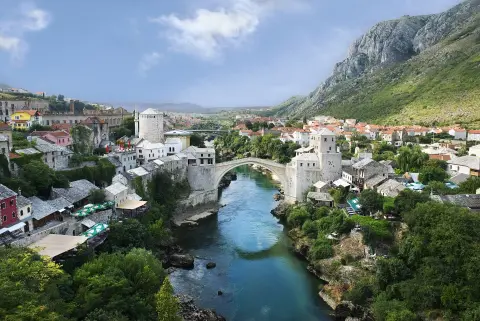
Welcome to Mostar. We have crossed into Bosnia and Herzegovina and driven up the Neretva valley to reach one of the most famous bridges in the world. Walk down through the old bazaar, past copper workshops and small shops, and you will see it: a single white stone arch, high above the green river. This is Stari Most, the Old Bridge. It is graceful and strong. It is also a bridge that was destroyed in war and rebuilt stone by stone. Today we will look at it from every side, learn its story, and spend some time in the old town around it.
The story of Stari Most, Mostar
In the sixteenth century, Mostar was a growing Ottoman town on the Neretva. A wooden bridge crossed the river here, but it was unsteady. Sultan Suleiman the Magnificent ordered a stone bridge, and the architect Mimar Hayruddin, a student of the great Mimar Sinan, designed it. It was completed in 1566. For more than four centuries it stood, a symbol of the city. The town's name comes from the mostari, the bridge keepers.
In the war of the 1990s, Mostar was badly damaged and divided. On 9 November 1993 the bridge collapsed after shelling by Bosnian Croat forces of the Croatian Defence Council. Its loss was felt far beyond Mostar, as a deliberate blow to shared heritage, and many people lost their lives in the city during the conflict.
After the war, an international effort rebuilt the bridge from 2001, using original techniques and stone from the same local quarries where possible. Pieces of the original were lifted from the river. The new bridge opened on 23 July 2004, and in 2005 the Old Bridge area of Mostar was added to the UNESCO World Heritage List.
The setting
Stari Most spans the Neretva river in a single arch about 29 metres long and 4 metres wide. It rises about 24 metres above the river at summer levels. At each end stands a fortified tower, Halebija and Tara, which guarded the crossing. The deck is steep and slippery, paved with ridged stone to help your footing. Around the bridge lies the old town, with cobbled lanes, mosques, stone houses with heavy stone roofs, and the old bazaar of Kujundžiluk. The river below is cold, fast and an intense green.
Why it matters
Stari Most is a masterpiece of Ottoman engineering and a powerful symbol of connection between communities. Its destruction in 1993 and reconstruction in 2004 made it known worldwide as a symbol of loss and repair. Today it is the heart of Mostar's old town, a UNESCO World Heritage Site, and a place where history is still close to the surface.
Your walk-through
The stops a guide would take you to, in order.
-
1
Kujundžiluk bazaar
We walk down through Kujundžiluk, the old bazaar street, on the east bank. Look at the stone shops with their small doors, and the copper plates and coffee sets hanging outside. This has been a crafts street since Ottoman times. Keep your eyes forward as the lane bends, and you will catch your first view of the bridge.
-
2
The bridge deck
Step onto the bridge. Walk carefully: the stone is steep and polished, with ridges to help your feet. At the top, look down into the green river far below. Feel the height. This single arch has no supports in the water. Imagine the builders in 1566, trusting their stone to stand without a pillar.
-
3
Bridge divers
At the centre you may see young men in swimsuits waiting to jump. Diving from the bridge is a long local tradition, and an annual diving competition has been held since 1968. Divers usually collect money from the crowd before they jump. It is dangerous: the water is cold and the drop is about twenty metres. Please never try it yourself.
-
4
Don't Forget stone
Near the bridge you will see a stone with the words Don't Forget, 1993. It marks the destruction of the bridge during the war. Pause here quietly. The bridge you just crossed is a careful reconstruction. Many people in Mostar lived through those years, and the memory is still close. This is a place for reflection, not photographs of yourself.
-
5
The riverbank view
Now walk down to the riverbank below the bridge. This is the classic view: the white arch, the towers at each end, the stone houses and the green river. You can see how the arch rises like a crescent. Many restaurants line the banks here, a good place to rest with Bosnian coffee.
-
6
Koski Mehmed Pasha Mosque
Finish at the Koski Mehmed Pasha Mosque, on the east bank, built in the early seventeenth century. For a small fee you can visit the courtyard and climb the minaret. From the top, the bridge and old town lie below you. Dress modestly, and remember this is an active place of worship.
Things you might not know
- The original bridge was completed in 1566 by Mimar Hayruddin, a student of Mimar Sinan.
- It collapsed on 9 November 1993 and reopened after reconstruction on 23 July 2004.
- Formal diving competitions from the bridge have been held each summer since 1968.
Researched November 2026 from: en.wikipedia.org, whc.unesco.org, en.wikipedia.org. Fees and hours change, so check on the day.