💎 Hidden gem · Al Wakrah, 18 km from central Doha
Souq Al Wakrah
A seaside souq in an old pearling town
🎧 Listen to this guide · about 5 min
Pop your earphones in and we'll walk you round.
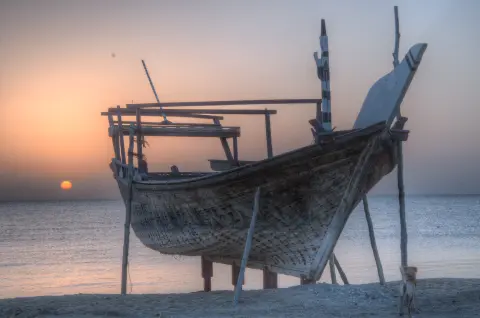
Welcome to Al Wakrah, an old fishing and pearling town on the coast just south of Doha. Down on the waterfront, you will find Souq Al Wakrah, a market built in traditional style right beside the sea. Sandy walls, wooden beams and shaded lanes lead you between small shops and restaurants, and then suddenly open onto the beach. Old wooden dhows lie on the sand, and the breeze carries the smell of salt and grilled fish. Most visitors to Qatar never come here. Locals do, especially on cool winter evenings, when families stroll the promenade and children play on the sand. This is a slower, gentler Doha.
The story of Souq Al Wakrah
Al Wakrah grew as a small fishing and pearling village on the coast. In the 1840s a British officer recorded that it had been founded by Ali bin Nasir, chief of the Ajman tribe, who moved here from Al Bidda, the old core of Doha. Some historians suggest Al Wakrah may have been one of Qatar's earliest towns.
When pearling was at its height, Al Wakrah was one of its great centres. A count from around 1920 put the number of boats in the town at about 300. In 1867 the town was sacked during a war between Qatar and Bahrain. A year later, in 1868, the British official Lewis Pelly met Mohammed bin Thani in Al Wakrah, and the agreement they signed recognised the Al Thani as Qatar's leading family.
The modern souq opened in late 2014, around Qatar National Day. It was designed in the style of the old town's buildings, with traditional architecture, replica dhows and a waterfront promenade. A heritage hotel followed in 2018, and the adjoining beach opened in 2017.
The setting
Souq Al Wakrah stretches along the shore, a low, sand-coloured cluster of buildings with wind towers, timber roof beams and shaded passages. The lanes run parallel to the sea, so you keep catching glimpses of the water between buildings. On the beach side, a promenade and sandy shore look out over shallow, calm water. Nearby, in the old town, are historic buildings such as Al Wakrah Fort, built in the early twentieth century, and the Abu Manaratain Mosque, dating from 1940, named for its two minarets.
Why it matters
Al Wakrah keeps alive the memory of the pearling era, when towns like this were the heart of Qatar's economy. The souq gives that memory a gentle, everyday form, where families can enjoy the sea and traditional architecture together. For visitors, it is a chance to see how Qataris themselves spend a relaxed evening, away from the busier city centre.
Your walk-through
The stops a guide would take you to, in order.
-
1
The souq lanes
Begin in the covered lanes of the souq. Look up at the wooden beams and the screened windows, built in the style of old Gulf houses. The shops sell spices, perfumes, traditional clothing and handicrafts. It is quieter than Souq Waqif, so you can browse without being rushed. Stop for a small cup of karak, the sweet, spiced tea loved across the Gulf.
-
2
The dhows on the sand
Walk through to the beach side. Here you will see wooden dhows resting on the sand. Boats like these once carried pearl divers out to the oyster beds for months at a time in summer. Look at the curved hulls and the way the planks are fitted together. These are the vessels that built this town.
-
3
The promenade and beach
Now stroll along the promenade by the sea. The water here is shallow and calm, and families come in the evening to walk and play. Look out across the Gulf. On clear days the horizon is wide and still, and at sunset the light turns gold over the water. It is one of the most peaceful seafronts near Doha.
-
4
Abu Manaratain Mosque
If you have time, walk a little way into the old town to see the Abu Manaratain Mosque, built in 1940. Its name means the one with two minarets, unusual for older mosques in Qatar. Admire it from outside, and be respectful, especially around prayer times.
-
5
Al Wakrah Fort
Finally, look for Al Wakrah Fort, built in the early twentieth century over the remains of an older fort. Notice its two round towers. For years it served as a police post. It is a small but telling reminder that this was once a town of real importance on the coast of Qatar.
Things you might not know
- Around 1920, Al Wakrah had roughly 300 boats, many used for pearling.
- In 1868, Lewis Pelly met Mohammed bin Thani here and signed an agreement recognising the Al Thani.
- The modern souq opened in late 2014, around Qatar National Day.
Researched November 2026 from: en.wikipedia.org, visitqatar.com. Fees and hours change, so check on the day.