💎 Hidden gem · Mehrauli, 16 km from central Delhi
Mehrauli Archaeological Park
A thousand years of Delhi under the trees
🎧 Listen to this guide · about 6 min
Pop your earphones in and we'll walk you round.
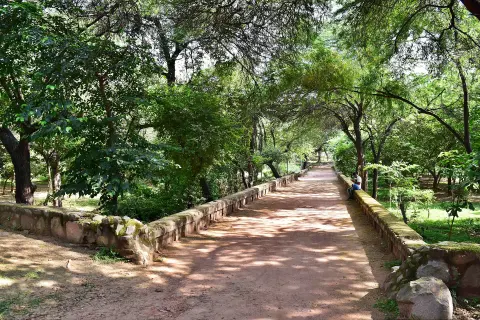
Welcome to Mehrauli Archaeological Park. You've just been to the Qutub Minar, and you can still see it rising above the trees. But here, across the road, the crowds disappear. Dirt paths wander through thorny scrub and old trees, and around each bend you find something: a crumbling tomb, a mosque with carved plaster, a stepwell sinking deep into the ground. Peacocks call. A goat might wander past. This land has been lived in for about a thousand years, without a break, and it shows. Wear good shoes, bring water, and let's go exploring.
The story of Mehrauli Archaeological Park
Mehrauli is one of the oldest inhabited parts of Delhi. In about 1060 the Tomar Rajputs built a fort here called Lal Kot, and parts of its walls still run through the park. Later, the Chauhan rulers expanded it, and after them came the sultans of Delhi, who made this area their first capital.
One of the oldest monuments in the park is the tomb of Ghiyas ud-Din Balban, the sultan who died around 1287. It is famous among architects because it contains the earliest surviving true arch in India, built with wedge-shaped stones locking each other into place. In the early sixteenth century, under the Lodis, the Rajon ki Baoli stepwell was built. Around the 1520s and 1530s came the mosque and tomb of Jamali Kamali. Jamali was a Sufi poet who lived through the reigns of the Lodis and the first Mughals. Who Kamali was remains a mystery, though he is buried beside Jamali.
In the nineteenth century, Sir Thomas Metcalfe, a British official at the Mughal court, converted the tomb of Quli Khan, a noble of Akbar's time, into a country house. He called it Dilkusha, the Delight of the Heart, and added follies around it. The area was later protected, and today it forms a large archaeological park.
The setting
The park covers about two hundred acres of rocky land on the edge of the Aravalli ridge. It feels more like woodland than a garden. Narrow trails and some paved paths link the monuments, which are spread out and sometimes half hidden in the trees. In the north are Jamali Kamali and the Rajon ki Baoli; towards the middle stand Balban's tomb and the remains of Lal Kot's walls; to the south-west, Quli Khan's tomb and Metcalfe's follies look across to the Qutub Minar. Signs are few, so a map on your phone helps. Expect some climbing over rough ground between sites.
Why it matters
Mehrauli Archaeological Park is described as the only area in Delhi with about a thousand years of continuous settlement. In one walk you can see Rajput walls, Sultanate tombs, Lodi stepwells, Mughal mosques and British follies. It's also an important green lung for south Delhi and a habitat for birds. Heritage walk groups bring locals here every weekend, and for many Delhiites it is where they first fell in love with their city's past. Many people never get past the Qutub Minar's ticket gate, and they miss all this.
Your walk-through
The stops a guide would take you to, in order.
-
1
Jamali Kamali Mosque
Start at the mosque of Jamali Kamali, built in red sandstone with grey and white marble touches. Look at the central arch and the carved medallions around it. It's an early Mughal-era mosque, built around the 1520s and 1530s. Inside the prayer hall, the arches are graceful and well proportioned. Walk around the side to see the small balconies on the walls. It's quiet here, with only the sound of birds.
-
2
Jamali Kamali Tomb
Beside the mosque is a small, square tomb with a flat roof. It looks plain from outside, but step inside and look up. The ceiling is covered with painted and incised plaster in red, blue and white, with Persian verses written by Jamali himself around the walls. Two graves lie here: the poet Jamali and the unknown Kamali. The tomb is sometimes locked, so ask the guard politely if he can open it.
-
3
Rajon ki Baoli
Follow the path to Rajon ki Baoli, a stepwell built in the early 1500s under the Lodis. Its name means the Masons' Stepwell, because masons are said to have lived nearby, though that's tradition. Stand at the top and look down: four levels of arched galleries step down to the water. In summer the water is low and green. In the hot months people once came down here to escape the heat.
-
4
Balban's Tomb
Now walk to the ruined tomb of Sultan Balban, who died around 1287. The roof has fallen, but look at the arches. These are among the earliest true arches in India, built with stones cut into wedges that lock together. Before this, builders in India mostly made arches by stacking stones in steps. It's a small change you might not notice, but it changed architecture across the subcontinent.
-
5
Lal Kot walls
Along the trail you'll pass sections of rough rubble wall and earthen ramparts. These are thought to be part of Lal Kot, the fort built by the Tomar Rajputs around 1060, and later strengthened by the Chauhans. Not much survives above ground, but stop and look along the line of the walls. You are standing in what some call the first city of Delhi.
-
6
Quli Khan's Tomb and Metcalfe's Dilkusha
End at the octagonal tomb of Quli Khan, a noble of Akbar's court. In the nineteenth century Sir Thomas Metcalfe turned it into a weekend house called Dilkusha. Nearby you'll see some of his follies, including a small canopy perched on a mound. From here there's a fine view back across the trees to the Qutub Minar. Pause, and think about all the rulers who have looked at this same view.
Things you might not know
- Balban's tomb, from around 1287, has the earliest surviving true arch in India.
- Lal Kot, built by the Tomar Rajputs around 1060, is considered the oldest fort in Delhi.
- A British official, Sir Thomas Metcalfe, turned a Mughal tomb here into a country retreat.
Researched November 2026 from: en.wikipedia.org, en.wikipedia.org, en.wikipedia.org. Fees and hours change, so check on the day.