⭐ Must-see · Historic Center
Plaza de Armas de Cusco
Heart of the Inca capital, layered in stone and faith
🎧 Listen to this guide · about 4 min
Pop your earphones in and we'll walk you round.
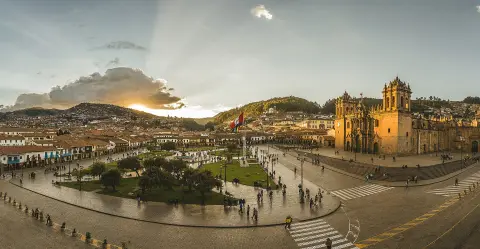
Stand with me in the Plaza de Armas. This open square has drawn people since Inca times. You feel the altitude at 3,399 metres, the cool mountain air, and the weight of centuries under your feet. Colonial arcades frame the space. Two great churches rise on ancient foundations. Locals cross it daily. Visitors pause to look up at the towers. The square still hosts festivals and quiet moments. It remains the living centre of Cusco, where Inca walls support Spanish walls and daily life unfolds against a backdrop of history.
The story of Plaza de Armas de Cusco
Inca rulers drained a swamp crossed by the Saphy River and shaped the space into Huacaypata, their main ceremonial square. It hosted victories, rituals, and gatherings. Palaces of Pachacuti, Huayna Capac, and Viracocha stood around its edges. The original square was larger, extending into what is now Plaza Regocijo.
Spanish forces arrived in 1533. They shrank the square and built on the palace sites. The Cathedral rose on Viracocha’s palace. The Jesuit church rose on Huayna Capac’s palace. In 1781 Túpac Amaru II was executed here after leading a major uprising. Earlier, Túpac Amaru I met the same fate in 1572. The square witnessed both colonial power and resistance.
Earthquakes damaged buildings in 1650 and later. Reconstructions kept the colonial character while preserving many Inca foundations. In 1983 the historic centre, with this plaza at its core, joined the UNESCO World Heritage list.
The setting
The square measures about 28,728 square metres at the heart of Cusco’s historic centre. Arcaded portales line three sides with restaurants and shops beneath stone arches. The northeast side holds the Cathedral complex, including the Church of the Triumph. The southeast side features the ornate façade of the Church of the Society of Jesus. A central cast-iron fountain from 1872 carries a statue often identified as Pachacutec. Visible Inca stonework appears at the base of several colonial walls, especially along Calle Loreto. The surrounding streets climb toward higher neighbourhoods while the square itself sits level and open to the sky.
Why it matters
Today the plaza anchors Cusco’s civic and religious life. Processions for Corpus Christi and Inti Raymi pass through it. It serves as a daily meeting place for residents and travellers. The layered architecture shows how Andean builders adapted European forms. Faith remains strong in the active churches. The square symbolises continuity from Inca capital to modern Peruvian city. Its UNESCO status protects this unique blend of cultures and eras.
Your walk-through
The stops a guide would take you to, in order.
-
1
Central fountain
Pause at the iron fountain installed in 1872. The statue above represents an Inca ruler, often called Pachacutec. Look down and imagine the original Huacaypata that once covered a much larger area. This spot once hosted public executions and now gathers people for photographs and rest.
-
2
Cathedral Basilica of the Assumption
Face the northeast side. The Cathedral stands on the palace of Inca Viracocha. Construction began around 1559 and finished in 1654. Inside you find Cusco School paintings, including the famous Last Supper with cuy and chicha. Step inside during open hours to see the silver altar and cedar choir stalls.
-
3
Church of the Triumph
Beside the Cathedral stands the first Christian church built in Cusco after the conquest. It commemorates a reported Spanish victory. Its modest exterior contrasts with the larger Cathedral next door. The site itself rests on earlier Inca structures.
-
4
Church of the Society of Jesus
Cross to the southeast side. This Jesuit church rose on the palace of Huayna Capac. Its baroque façade is among the most elaborate in the city. Rivalry with the Cathedral shaped its design. The interior holds rich altarpieces and colonial art.
-
5
Portal de Panes and northwest arcades
Walk the covered walkway on the northwest side. These arcades stand on the palace of Pachacuti. Shops and cafés now occupy the spaces once used by Inca nobility. Notice the wooden balconies above and the stone arches that frame views across the square.
-
6
Calle Loreto and visible Inca walls
Step to the southeast corner near Calle Loreto. Here the colonial walls rest directly on finely fitted Inca stonework. The contrast of styles shows how the city was rebuilt on its original foundations. This narrow street leads toward higher parts of the historic centre.
Things you might not know
- The original Inca square was roughly twice the size of today’s plaza and stretched across what is now Plaza Regocijo.
- The Cathedral’s famous Last Supper painting by Marcos Zapata shows Jesus and the apostles eating cuy, a traditional Andean dish.
- Túpac Amaru II was executed in the square in 1781 after leading the largest indigenous uprising of the colonial period.
Researched November 2026 from: en.wikipedia.org, es.wikipedia.org, whc.unesco.org. Fees and hours change, so check on the day.