⭐ Must-see · Frederiksstaden, 2 km from central Copenhagen
Amalienborg Palace and the Marble Church
Four palaces, one square and a guard at noon
🎧 Listen to this guide · about 5 min
Pop your earphones in and we'll walk you round.
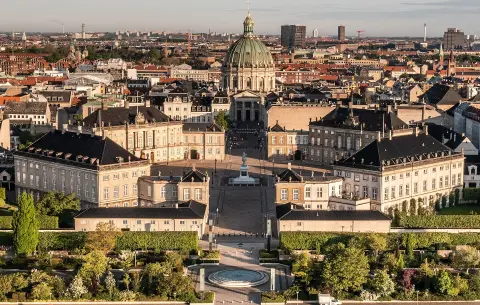
Welcome to Amalienborg, the home of the Danish royal family. Stand in the middle of this great eight-sided square and turn slowly around. Four almost identical palaces face each other, elegant and calm, with the bronze statue of a king on horseback in the centre. Guards in tall black bearskin hats march slowly in front of the doors. Behind you, the huge green dome of the Marble Church rises over the rooftops. In front of you, across the harbour, sits the modern Opera House. It is a perfect line of sight, old and new. Let's walk the square, meet the royal guards, peek inside the palace museum, and then climb toward that great dome.
The story of Amalienborg Palace and the Marble Church
Amalienborg was built between 1750 and 1760 as the centrepiece of a new district called Frederiksstaden, named after King Frederik V. The architect was Nicolai Eigtved. He designed the square and the four palaces, but he died in 1754, and Lauritz de Thurah finished the work to his plans. The palaces were built not for the king, but for four noble families.
Everything changed in 1794. A fire destroyed Christiansborg Palace, and the royal family suddenly needed a new home. They bought the four palaces and moved in. They have lived here ever since. Today King Frederik X and Queen Mary live in Frederik VIII's Palace, and Queen Margrethe II has lived in Christian IX's Palace since 1967.
The equestrian statue of Frederik V in the centre was made by the French sculptor Jacques Saly. Work began in 1753 and it was unveiled in 1771. The Marble Church, properly called Frederik's Church, was also begun in Eigtved's time, but money ran out and it stood unfinished for more than a century. It was finally completed in 1894 with funding from the businessman C. F. Tietgen.
The setting
The square is an octagon, with a palace on each of four diagonal sides and streets leading in on the others. The palaces are Rococo, with soft grey stone, tall windows and restrained decoration. The statue of Frederik V stands in the middle. A long axis runs from the Marble Church, through the square, across a formal garden, Amaliehaven, to the harbour and the Opera House on the far side. The church's dome, one of the largest in Scandinavia, is green copper on a ring of columns.
Why it matters
Amalienborg matters because it is still a working royal home. The monarchy here is not a museum piece. When the King is in residence, his flag flies over the palace. The square is also where Danes gather on royal birthdays and big national moments, waving flags under the balcony. Architecturally, Frederiksstaden is seen as one of the finest examples of Rococo town planning in Europe.
Your walk-through
The stops a guide would take you to, in order.
-
1
The square and statue
We start beside the statue of Frederik V. He is dressed as a Roman emperor, sitting calmly on his horse. Look at how the four palaces mirror each other around you. This was planned as one complete design, a show of royal order and good taste. On royal birthdays, this square fills with people waving red and white flags.
-
2
The guard boxes
Look at the guards in their bearskin hats and dark blue uniforms. These are the Royal Life Guards. Please give them space and do not step in their path, they will let you know firmly if you do. Every day at noon, the changing of the guard takes place here. The relief guard marches from Rosenborg Castle, leaving around 11:30, through the city streets.
-
3
Christian VIII's Palace, the museum
One palace, Christian VIII's, holds the Amalienborg Museum. Inside you can see the private studies and living rooms of kings and queens from the 19th and 20th centuries, kept as they were. Notice how personal they feel, with family photographs, desks and favourite chairs. It is a rare chance to step inside a palace where the royal family still lives next door.
-
4
Frederik VIII's Palace
Across the square is Frederik VIII's Palace, the home of King Frederik X and Queen Mary. When the King is at home, the royal standard flies over this building. Look up and see if it is flying today. Fans of the royal family gather here on special days, hoping to see a wave from the balcony.
-
5
The Marble Church
Walk out along Frederiksgade to the Marble Church. Its dome is one of the largest in Scandinavia. The church was begun in the time of Eigtved, then abandoned for over a century, and finished only in 1894. Step inside to see the round interior and the painted dome high above. In some seasons you can join a guided climb up to the dome for a view across the city.
-
6
Amaliehaven and the harbour
Finish by walking back through the square and down to Amaliehaven, the small garden on the waterfront. Turn around and see the perfect line from the harbour, through the square, to the dome of the Marble Church. Then look across the water to the Opera House. Two very different centuries, lined up on one axis.
Things you might not know
- The royal family moved here in 1794 after Christiansborg Palace burned.
- The Marble Church stood unfinished for more than a century and was completed in 1894.
- The statue of Frederik V took about 18 years from start to unveiling, from 1753 to 1771.
Researched November 2026 from: en.wikipedia.org, denkongeligesamling.dk, visitdenmark.com. Fees and hours change, so check on the day.