⭐ Must-see · Plaza Independencia, Downtown Cebu, 5 km from central Cebu
Fort San Pedro
Coral-stone walls guarding the oldest Spanish city in the islands
🎧 Listen to this guide · about 5 min
Pop your earphones in and we'll walk you round.
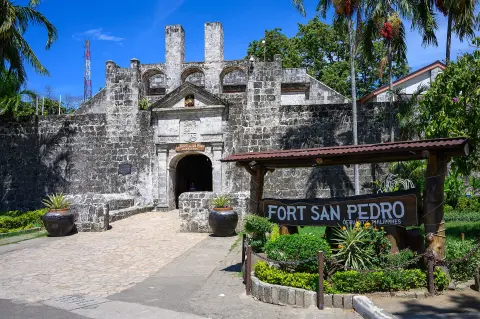
Welcome to Fort San Pedro, the little fort that started a city. After the heat and traffic of downtown, step through this gate and the noise drops away. You are inside a triangle of thick coral-stone walls, with old cannons resting on the ramparts and a garden of palms and flowering shrubs in the middle. Out past the walls are the piers where ferries leave for Bohol and the other islands. It is not a huge place. You can walk the walls in a few minutes. But stand still a while, feel the sea breeze on the bastions, and you can picture the days when this was the edge of the Spanish world in Asia.
The story of Fort San Pedro
When Miguel Lopez de Legazpi's expedition arrived in 1565, one of the first things the Spanish built was a fort, made of wood and earth, beside the harbour. It protected the new settlement that would become Cebu, the first Spanish city in the Philippines. The wooden fort was later replaced in stone to defend against raids from the sea. The structure you see today dates to 1738, the year carved over the gate.
Under American rule after 1898, the fort became part of a military barracks. Between 1937 and 1941 it housed a school. During the Japanese occupation in the Second World War it served as a stronghold, and in the fighting to retake Cebu in 1945 it was used as an emergency hospital. After the war it was an army camp, then a garden, and in the late 1950s even held a small zoo.
By 1968 it was badly ruined. Architect Leonardo Concepcion led a restoration using coral stone, backed by the city, the national travel board and the Cebu Zonta Club. The fort has been damaged since by the 2013 earthquake, Typhoon Odette in 2021 and the 2025 Cebu earthquake, and repaired each time. It was declared a National Cultural Treasure in 2020.
The setting
The fort sits at the water's edge, at the south end of Plaza Independencia, a large leafy square with a monument to Legazpi. It is a triangle, two sides facing the sea and one facing the land. The walls are about six metres high and over two metres thick, and the whole perimeter runs about 380 metres. Three bastions stand at the corners, named La Concepcion, Ignacio de Loyola and San Miguel. Fourteen cannons were once mounted here. Inside is a courtyard of about two thousand square metres, now a garden and open-air stage. The old officers' quarters hold a small museum of maps, documents and objects from the colonial era.
Why it matters
Fort San Pedro is a reminder that Cebu, not Manila, was the first Spanish capital in the Philippines. The fort is one of the oldest stone defences in the country, and it tracks the whole story of the islands, from Spanish rule through American occupation, war and recovery. Today it is one of the few calm green spaces in the old downtown, used for weddings, school trips and festivals. Its repeated repairs after earthquakes and typhoons also show how much the city values it.
Your walk-through
The stops a guide would take you to, in order.
-
1
Plaza Independencia
Begin in Plaza Independencia. This green square was the old parade ground of Spanish Cebu. Look for the obelisk honouring Legazpi, the conquistador who founded the city in 1565. On weekends families picnic under the trees. Walk toward the low grey walls at the far end. That is our fort, standing exactly where the first wooden stockade went up.
-
2
The gate
Pause at the gate. Look for the date 1738 above the entrance, the year this stone fort was completed. The coat of arms recalls the Spanish crown. The walls around the door are made of coral stone, cut from reefs and laid in thick blocks. Run your hand over it and you may feel tiny shell fossils in the surface.
-
3
Inner courtyard
Step into the courtyard. Once soldiers drilled here. Later it became a school, a wartime refuge and hospital, and even a zoo. Today it is a quiet garden with an open-air stage. Notice how protected it feels. The thick walls block the street noise and trap the shade. On hot afternoons this is one of the coolest places downtown.
-
4
The ramparts and cannons
Climb up onto the walls. From here you look over the harbour, the piers and the ferries heading out to Bohol and Mactan. The old cannons point out to sea, where raiders once came from. Walk toward the bastions at the corners. The Spanish named them for saints and for the Immaculate Conception, a reminder that faith and defence went together here.
-
5
Museum rooms
Finish in the small museum in the old officers' quarters. You will find maps, documents and objects that trace Cebu from the Spanish era to the American period. Displays change, so take your time with what is on show. When you step out again, Magellan's Cross and the Basilica are only a ten-minute walk away.
Things you might not know
- The gate bears the date 1738, when the present stone fort was finished.
- Its walls are about 6 metres high and 2.4 metres thick.
- In 1957 a plan to demolish the fort for a new city hall was dropped after public opposition.
Researched November 2026 from: en.wikipedia.org, sunstar.com.ph, suroy.ph. Fees and hours change, so check on the day.