⭐ Must-see · Giza Plateau, 20 km from central Cairo
Pyramids of Giza and the Great Sphinx
Three kings, one lion, and four and a half thousand years
🎧 Listen to this guide · about 6 min
Pop your earphones in and we'll walk you round.
Welcome to the edge of the desert. Look behind you and you see the city, roofs and minarets stretching to the haze. Look ahead and the land simply changes. Sand, rock, and then the pyramids, rising like mountains someone decided to build by hand. People have stood on this exact ridge for thousands of years and felt what you are feeling now. Greek travellers did. Roman soldiers did. Medieval scholars did. Today we will walk among three royal tombs, stand beside the stones that built them, and finish face to face with the Sphinx. Drink water, wear a hat, and take your time. These monuments have waited a very long time for you. They can wait a few more minutes while you simply look.
The story of Pyramids of Giza and the Great Sphinx
The Giza pyramids were built during Egypt's Fourth Dynasty, in the Old Kingdom, roughly between 2600 and 2500 BC. The first and largest belongs to King Khufu, built around 2560 BC. His son Khafre built the second, and Menkaure the third, much smaller one. Each pyramid was the centre of a complex, with a mortuary temple, a causeway, and a valley temple near the edge of the Nile flood.
The Great Pyramid rose to about 146 metres. It held the record as the tallest structure made by human hands for nearly four thousand years, until the spire of Lincoln Cathedral in England passed it in the fourteenth century. Most Egyptologists now agree it was built by organised teams of paid, fed and housed workers, not slaves. Their tombs and bakeries have been found just south of the plateau.
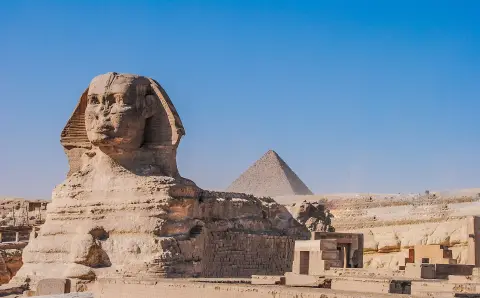
The Great Sphinx is usually linked to Khafre. It was carved straight out of the bedrock, a lion's body with a king's head. Sand buried it to the shoulders again and again. Around 1400 BC Prince Thutmose, so the story on his stone tells us, fell asleep in its shadow and dreamed it promised him the throne if he cleared the sand. He did, and he became king. In 1979 the plateau joined the UNESCO World Heritage list as part of Memphis and its Necropolis.
The setting
The plateau is a limestone shelf on the west bank of the Nile, at the meeting point of the green valley and the Western Desert. The three pyramids line up roughly on a diagonal from northeast to southwest, with Khufu's nearest the city. Around them lie rows of flat-topped mastaba tombs for nobles and officials, laid out like streets. The Sphinx sits lower down, in a hollow quarried out of the rock, facing due east toward the rising sun. Beside it stands Khafre's valley temple, built of huge pink granite blocks brought from Aswan, far to the south. Khafre's pyramid still keeps a cap of its original smooth casing stones near the top, a hint of how all three once shone in the sun.
Why it matters
Giza is where many people first meet ancient Egypt, and it still shapes how the world imagines it. Archaeology here has not stopped. Excavations of the workers' town and new scans of the Great Pyramid keep adding to what we know about how a state could organise tens of thousands of people over decades. The plateau is also a living part of Cairo. Families come at weekends, camel men work the same paths as their grandfathers, and the new Grand Egyptian Museum just down the road now holds the treasures that once filled tombs like these.
Your walk-through
The stops a guide would take you to, in order.
-
1
The Great Pyramid of Khufu
Start at the north face and put your hand on a block. Each one weighs more than a car, and there are an estimated two point three million of them. The original entrance is above you. The opening you may use today was forced by robbers, or perhaps by Caliph al-Ma'mun's men in the ninth century, so the story goes. If you have the extra ticket, the climb inside to the King's Chamber is steep, hot, and unforgettable.
-
2
The Eastern Cemetery and Queens' Pyramids
On Khufu's east side stand three small pyramids, built for royal women of his family. Around them lie the stone mastabas of princes and officials, arranged in neat rows. Being buried near the king was the highest honour. In 1954, south of the Great Pyramid, archaeologists found a dismantled cedar boat sealed in a pit. That boat now sits in the Grand Egyptian Museum.
-
3
Khafre's Pyramid
This one looks taller than Khufu's, but it is a trick. It stands on higher ground and is slightly smaller. Look up at the very top. Those pale, smooth stones are the last of its original casing. Once all three pyramids were dressed like this, polished white limestone that would have glowed in the morning light.
-
4
Panoramic Viewpoint
Out in the desert to the southwest is the classic view, all the pyramids lined up across the sand. Here you see the plan the builders worked to, three kings in a row, each smaller than his father. Menkaure's pyramid is the smallest of the three, and its lower courses were once faced in red granite. It is a good place to sit, breathe, and take your photograph.
-
5
Khafre's Valley Temple
Walk down to this squat building of pink granite. The blocks were cut in Aswan and floated hundreds of kilometres down the Nile. Inside, the pillars are plain and perfect, with almost no decoration. It feels modern, even severe. This is where, it is thought, the king's body was received before the procession up the causeway to his pyramid.
-
6
The Great Sphinx
And here he is. A lion's body about 73 metres long, with a royal head wearing the striped nemes headcloth. Between his paws stands Thutmose's Dream Stele. And the nose? It is not Napoleon's fault, whatever you hear. Drawings made before his army arrived already show it missing, and the medieval historian al-Maqrizi blamed a fourteenth-century zealot.
Things you might not know
- The Great Pyramid was the tallest human-made structure on Earth for nearly 4,000 years.
- The pyramids' sides are aligned to the four cardinal directions with remarkable precision.
- A sealed pit beside the Great Pyramid held a full-size cedar boat, found in 1954.
Researched November 2026 from: whc.unesco.org, egymonuments.gov.eg, en.wikipedia.org, en.wikipedia.org. Fees and hours change, so check on the day.