⭐ Must-see · Fenway–Kenmore, 4 km from central Boston
Fenway Park
The Green Monster, a red seat and over a century of baseball
🎧 Listen to this guide · about 6 min
Pop your earphones in and we'll walk you round.
Welcome to Fenway. Listen. Even on a quiet tour day, you can almost hear the organ and the crowd. Fenway Park opened in 1912 and has been home to the Boston Red Sox ever since. It is the oldest ballpark in Major League Baseball, squeezed into a city block between narrow streets. That is why it has such odd angles and that towering green wall in left field. Here, fans have suffered for decades and celebrated wildly. Come with me past the brick front on Jersey Street, up into the stands, and if we are lucky, out onto the top of the Monster.
The story of Fenway Park
Fenway Park opened on 20 April 1912. The news was overshadowed by the sinking of the Titanic just days before. The Red Sox won the World Series that very first season, and again in 1915, 1916 and 1918. Then came a long drought. After 1918 the club did not win another title for 86 years, a stretch fans blamed on a supposed curse after the sale of Babe Ruth to New York.
Fires damaged the park in 1926 and again in early 1934, and new owner Tom Yawkey rebuilt much of it. The tall left-field wall was not painted green until 1947. Ted Williams played his whole career here, and in June 1946 he hit a home run measured at 502 feet, the longest in the park's history.
In 2004 the Red Sox finally won the World Series again, and they won more in 2007, 2013 and 2018. The 2013 title was clinched here at Fenway, the first time the team had won a Series at home since 1918. In 2003 seats were built on top of the Green Monster. In 2012, the park's centennial year, Fenway was added to the National Register of Historic Places. The park was built by the club's owner of the time, John I. Taylor, whose family owned the land. The name came from the Fenway, the marshy area of the Back Bay Fens nearby.
The setting
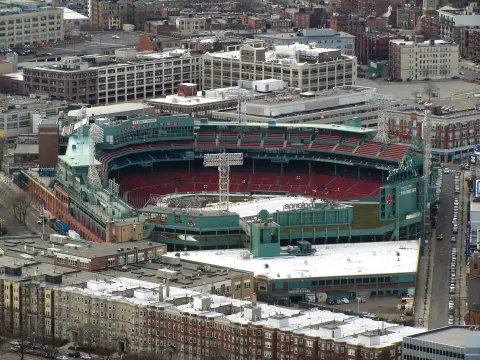
Fenway sits in the Fenway–Kenmore neighbourhood, wedged between Lansdowne Street and Jersey Street, with the Massachusetts Turnpike just behind. Because the city block is irregular, so is the field. In left field rises the Green Monster, a wall about 37 feet high, with a scoreboard still worked by hand from inside. Right field is short along the foul line, where a pole called Pesky's Pole stands just 302 feet from home plate. The seats are tight and close to the field, many of them wooden and narrow. Beyond the left-field wall, the red and blue Citgo sign glows over Kenmore Square.
Why it matters
Fenway is one of only a few ballparks from baseball's early days still in use, and the oldest of all. While most cities built new stadiums, Boston kept and restored this one. It is a gathering place for the whole region, and a game here is a ritual of hot dogs, songs and old rivalries, especially with the New York Yankees. Even in the off-season, its walls tell the story of American baseball across more than a century, from Babe Ruth to the curse-breaking team of 2004.
Your walk-through
The stops a guide would take you to, in order.
-
1
Jersey Street front
Start outside on Jersey Street, formerly known as Yawkey Way. Look at the brick facade and the old lettering. On game days this street closes and fills with food stalls and music. Notice how the ballpark fits into the city, with offices and bars right across the road. Fenway was built for streetcar crowds in 1912, not for cars, and it still feels like part of the neighbourhood.
-
2
Grandstand behind home plate
Inside, climb to the seats behind home plate and take in the whole field. The grass is a famous shade of green. Look left to the great wall and right to the low fences of the bullpen. Every angle is a little different, because the builders had to fit the field into the block. Players say no ballpark plays quite like it. Sit in one of the old wooden seats, made for smaller people a century ago.
-
3
The Green Monster
Now the star. The wall in left field stands about 37 feet tall. It was not painted green until 1947, and the nickname came later. On the tour you can usually climb up to the Monster seats added in 2003. From up here you look straight down onto left field and across the whole park. Batters hit fly balls that would be outs elsewhere off this wall, and left fielders learn every dent.
-
4
Hand-operated scoreboard
Look at the bottom of the Monster. That is the scoreboard, still updated by hand. Workers sit inside the wall and slide metal number plates into slots during games. Look closely at the vertical strips and you will find dots and dashes. They spell out in Morse code the initials of former owners Tom and Jean Yawkey. Few fans notice them, so now you are one of the few.
-
5
The Red Seat
In the right-field bleachers, among all the green seats, one is painted red. It marks where Ted Williams' home run landed on 9 June 1946, measured at 502 feet. Legend says the ball struck a fan named Joseph Boucher on the head, going through his straw hat. Stand by it and look back toward home plate. It is a very long way. Many call Williams the greatest hitter who ever lived.
-
6
Pesky's Pole
Finish at the right-field foul pole, only 302 feet from home plate, the shortest outfield distance in the major leagues. It is named after Johnny Pesky, a Red Sox shortstop and later coach, who spent decades with the club. Fans sign their names on the pole, a sort of good-luck tradition. Look for a quiet corner of yellow paint covered in signatures, and imagine a lazy fly ball curling just around it.
Things you might not know
- Fenway opened on 20 April 1912, five days after the Titanic sank.
- The left-field wall was not painted green until 1947.
- The scoreboard hides the Yawkeys' initials in Morse code.
Researched November 2026 from: en.wikipedia.org, mlb.com, nps.gov. Fees and hours change, so check on the day.