🚗 Day trip · Mykines, Argolis, 120 km from central Athens
Mycenae
The Lion Gate and the kingdom of Agamemnon
🎧 Listen to this guide · about 5 min
Pop your earphones in and we'll walk you round.
Welcome to Mycenae. We have driven deep into the Peloponnese, through orange groves and rolling hills, to a rocky citadel between two mountains. This is older than anything you saw in Athens. More than three thousand years ago, a powerful kingdom ruled from these walls, and later Greeks told stories of its king Agamemnon, who led the Greeks to Troy. As we walk up, look at the giant stones in the walls. The ancient Greeks believed only giants, the Cyclopes, could have lifted them. Soon we will pass under two stone lions guarding the gate. This is a place of legends, kings and gold. Let us step into it.
The story of Mycenae
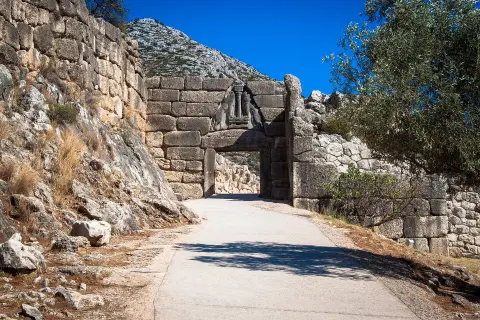
Mycenae was the leading centre of the Late Bronze Age civilisation we now call Mycenaean. At its height, around 1350 BC, the citadel and its lower town may have housed about 30,000 people. Around that time the walls were rebuilt with enormous blocks, in the style called Cyclopean. Around 1250 BC the Lion Gate was added as the grand main entrance.
Inside, a circle of royal shaft graves, known as Grave Circle A, dates to the sixteenth century BC. Outside the walls, great beehive shaped tombs called tholoi were built for the elite, including the so-called Treasury of Atreus. After about 1200 BC, the Mycenaean world collapsed, and the citadel declined. In 468 BC troops from Argos captured Mycenae and destroyed its walls.
In 1876 the German businessman and amateur archaeologist Heinrich Schliemann excavated Grave Circle A, searching for Agamemnon. He found rich burials, including a gold funeral mask he called the Mask of Agamemnon. In fact, it is centuries older than the Trojan War of legend. In 1999 UNESCO listed Mycenae and nearby Tiryns as a World Heritage Site.
The setting
The citadel sits on a hill about 274 metres above sea level, between two higher mountains, overlooking the plain of Argos. It is protected by steep ravines on several sides. Massive Cyclopean walls enclose the summit, entered through the Lion Gate on the northwest. Inside, paths climb past Grave Circle A to the palace on the top, with its throne room and central hall. A secret passage leads to an underground cistern on the far side. Below the citadel are the tholos tombs, including the Treasury of Atreus. A modern museum sits near the entrance.
Why it matters
Mycenae is where Greek myth and archaeology meet. Its name gave us the word Mycenaean for an entire civilisation, the first to write an early form of Greek. The epics of Homer and the tragedies of Aeschylus are set in its world. For visitors, it is a powerful reminder of how old Greek civilisation is, and how legends sometimes grow from real places and powerful people.
Your walk-through
The stops a guide would take you to, in order.
-
1
The Treasury of Atreus
Start at the great tholos tomb below the citadel. Walk down the long stone passage and through the huge doorway; the lintel block alone weighs many tonnes. Inside, look up at the dome, made of perfect rings of stone rising to a point. For over a thousand years, until Roman times, no wider dome was built. Speak softly and listen to the echo.
-
2
The Cyclopean walls
Now walk up to the citadel. Look at the walls. Some blocks are bigger than a car. Later Greeks believed the Cyclopes, one eyed giants, built them. The real builders used ramps, levers and great skill. Run your hand over the stone and imagine the effort it took, more than three thousand years ago.
-
3
The Lion Gate
Here is the Lion Gate, built around 1250 BC. Above the entrance, two lions, or perhaps lionesses, face each other with their paws resting on a column. Their heads, probably made separately, are lost. It is the oldest large sculpture in Europe still standing in its original place. Walk through, as kings and warriors once did.
-
4
Grave Circle A
Just inside on your right is a ring of standing slabs. This is Grave Circle A, where Schliemann dug in 1876. The shaft graves held royal burials with gold masks, swords and jewellery. Most of those treasures are now in the National Archaeological Museum in Athens. Schliemann believed he had found Agamemnon, but the graves are much older.
-
5
The palace
Climb to the summit. Here stood the palace, with a central hall called the megaron, its hearth in the middle and columns around it. In legend, this is where Agamemnon returned from Troy. From up here, look across the plain of Argos. You can see why rulers chose this hill: it controls the land and the routes between the mountains.
-
6
The underground cistern
On the far side, find the passage leading down to an underground cistern, built so the citadel could hold out under siege. Steps disappear into darkness. It is dark and slippery, so only go a little way, and use a light. It shows how practical and careful these Bronze Age engineers were.
Things you might not know
- The Mask of Agamemnon found by Schliemann is more than 300 years older than the Trojan War of legend.
- The Lion Gate, around 1250 BC, is the oldest monumental sculpture in Europe still standing in its original place.
- Mycenae and Tiryns were listed together as a UNESCO World Heritage Site in 1999.
Researched November 2026 from: whc.unesco.org, en.wikipedia.org, en.wikipedia.org. Fees and hours change, so check on the day.