🚗 Day trip · Archaia Korinthos, Peloponnese, 85 km from central Athens
Ancient Corinth
Temple, Roman city and a fortress in the sky
🎧 Listen to this guide · about 5 min
Pop your earphones in and we'll walk you round.
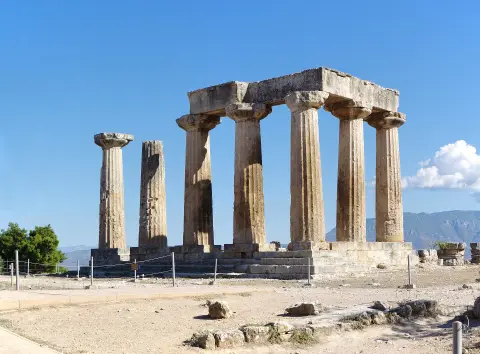
Welcome to Ancient Corinth. We crossed the narrow isthmus to get here, the thin neck of land joining mainland Greece to the Peloponnese. Corinth controlled that bridge, and that made it rich and powerful. In front of you are the remains of a great city: columns, shops, fountains and wide paved streets. Above them stand seven heavy columns of an archaic temple. And above everything rises a huge rock, Acrocorinth, with walls running along its top. On a clear day you can see two seas from up there. Walk with me through Greek and Roman Corinth, where merchants, sailors and early Christians all left their mark.
The story of Ancient Corinth
Corinth was one of the largest and wealthiest cities of ancient Greece. It sat between two gulfs and controlled trade across the isthmus. Its Temple of Apollo was built in the Doric style around the middle of the sixth century BC, and seven of its original 38 columns still stand.
In 146 BC the Roman general Lucius Mummius captured and burned the city, killing many of its men and selling women and children into slavery. Corinth lay largely empty for a century. Then in 44 BC, shortly before his assassination, Julius Caesar refounded it as a Roman colony. It grew rich again and became the capital of the Roman province of Achaea.
The apostle Paul arrived around AD 49 or 50 and stayed for about eighteen months, founding a Christian community. His letters to the Corinthians are part of the Bible. Earthquakes struck the city several times in late antiquity. In 1858 another earthquake destroyed the village around the ruins, and New Corinth was built a few kilometres away. Systematic excavations, led by the American School of Classical Studies at Athens, began in 1896 and still continue.
The setting
The ancient city lies on a terrace below the massive rock of Acrocorinth, which rises about 575 metres above sea level. The main excavated area is the Roman forum, a large open space lined with shops, temples and public buildings. The Temple of Apollo stands on a low rise at its northwest corner. To the north lies the Lechaion Road, the paved street that led to the harbour. Nearby is the Peirene Fountain, a monumental spring house. A museum near the entrance holds sculpture, mosaics and pottery. Acrocorinth's medieval walls and gates crown the rock above.
Why it matters
Corinth tells a long story: Greek city state, Roman colony, early Christian centre and medieval fortress. It is one of the few places where you can see the shift from Greek to Roman to Byzantine life in one visit. For Christians, it is a pilgrimage site linked to Saint Paul. For historians, Acrocorinth is a lesson in strategy, held by Byzantines, Franks, Venetians and Ottomans over the centuries.
Your walk-through
The stops a guide would take you to, in order.
-
1
The Archaeological Museum
Begin in the museum. Look for the Roman mosaics, the painted Corinthian pottery and the statues from the forum. Corinthian pottery was exported all over the Mediterranean in the seventh and sixth centuries BC. Find the small animal friezes painted on the vases; they show how skilled the city's workshops were.
-
2
Temple of Apollo
Walk up to the temple. Seven thick columns still stand, each carved from a single block of limestone rather than separate drums. This gives them their solid, heavy look. They were built in the sixth century BC, making this one of the oldest Doric temples in Greece. Stand back and see Acrocorinth rising behind it.
-
3
The Roman Forum and the Bema
Now walk into the open forum. In the middle stands the Bema, a raised speaker's platform. Christian tradition says that here, around AD 51, Paul was brought before the Roman governor Gallio, who declined to judge him. Later a church was built on the spot. Picture the forum busy with traders and officials.
-
4
Peirene Fountain
At the edge of the forum is the Peirene Fountain, a grand spring house with arched chambers. Water still flows in the channels behind it. In myth, Peirene was a nymph whose tears for her son created the spring. It is also linked to the legend of the winged horse Pegasus, said to have been tamed here by the hero Bellerophon.
-
5
Lechaion Road
Walk down the paved Lechaion Road, the main street that ran to the harbour on the Gulf of Corinth. Notice the wide stone slabs and the shops along the sides. Goods from across the Mediterranean passed along this road. Imagine the noise of carts and voices, and the smell of the sea drifting up.
-
6
Acrocorinth
If you have the time and energy, drive or walk up to Acrocorinth. Pass through its three gates, built and rebuilt over many centuries. From the top you can see both the Gulf of Corinth and, on clear days, toward the Saronic Gulf. It is a wild and windy place, with ruined chapels, cisterns and a sweeping view.
Things you might not know
- Seven of the Temple of Apollo's original 38 columns still stand, each cut from a single block of stone.
- Julius Caesar refounded Corinth as a Roman colony in 44 BC, a century after it was destroyed.
- Saint Paul lived in Corinth for about eighteen months, and his letters to its Christians are in the Bible.
Researched November 2026 from: en.wikipedia.org, en.wikipedia.org, en.wikipedia.org. Fees and hours change, so check on the day.